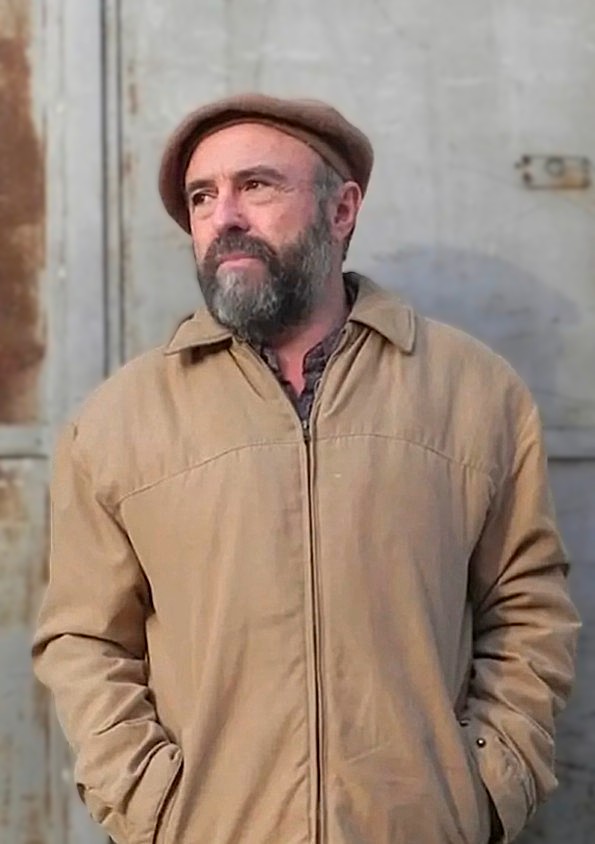
Hugo Giovanetti Viola. Photograph Guillermo Wood.
Hugo Giovanetti Viola (Uruguay, 1948) is a multifaceted artist who has worked in poetry, narrative, popular song, essays, theater, film, journalism, and cultural production. A guitar teacher since 1967 and director of the Taller Literario Universo since 1990, he co-founded the magazine Universo in 1970. During Uruguay’s de facto government, he co-founded the censored magazine Palabra and served as a correspondent for Mexico’s Plural, winning its first prize in Poetry in 1982. His novel Morir con Aparicio is considered a foundational classic of the Uruguayan new historical novel and was used as a textbook at the Sorbonne for over a decade. In 2005, he co-founded the Montevideano Laboratorio de Artes, followed by the Escuela de Cineastas del Uruguay in 2010. His works have been adapted for theatre and film, and in 2006 he was honoured at the Sorbonne alongside Juan Carlos Onetti, Felisberto Hernández, Marosa Di Giorgio, and Enrique Amorín as one of the most important writers of the second half of the 20th century. His life and work inspired the documentary La sombra fisurada (2015). In 2020, the Montevideano Laboratorio de Artes published the bilingual virtual novel Viaje al fin del miedo / Creer o reventar, translated into French. In 2022, the Hugo Giovanetti Viola Virtual Library / Complete Works 1973-2022 was launched in Uruguay and Austria. His work has been translated into French, English, and Finnish, and his entire oeuvre is currently available at http://www.hugogiovanettiviola.uy
Ulises Paniagua Olivares

(or that astral prayer beyond the absurd
when the mouth sags as if buried). Photograph Gavin Young on Pexels.com
Desiderata
Bone Weddings (1978)
We do not pursue masks with amber
nor a hollow flag like a visor / nor a gaze
even remotely hazy because of the children.
We fight beyond the operating rooms
of unsanctified, insulting misfortunes
of the blood of the sea or genocide
(or that astral prayer beyond the absurd
when the mouth sags as if buried).
Let them seek farther / farther south / farther inside my skull
a smile
born against everything and for everyone.

Photograph Tatyana Novoselova on Pexels.com
The Rose of Pain
Bone Weddings (1978)
Holding a wounded, spinning rose
like the two faces of a lighthouse
and its fatal orientation toward beauty or humiliations
I submerge, emerging through the light.
The dark corals of the lunar nape are devouring me
and a future of shared graves
and a region where animal souls flood us without speech
perfect the Father until he disintegrates.
Every night I traverse the questions
as if wandering / sailing / crashing
against fierce and fleeting stars
because there will be no garbage or injustice
that, in the post-error, is resurrected.
We must then repress
weaknesses too akin to paralysis
but not balance ourselves by forgetting
the concentric fields where humans and birds
go mute / and make of our cry a grave joy.
Once the rose is separated from pain
and your fruity smile and your furious forgiveness are offered
you will purely sweep away the dregs of blood
without innocence or writhing
surviving hell and disenchantments.
Beauty ordains your battles
our communing, stubborn flesh when it chooses the history
of the couple / the child / the companion
and a morning trembling on the sea
and a bird spinning for birds.
You will never fear that the lighthouse dies
but rather, smoking
you will weave new edges, its light widened through the night:
only a naked gold / toward silence.

Hind Rejab, murdered in cold blood by the IDF while they were ‘mowing the lawn‘ in Gaza
Turns
The Sky Between the Teeth (1986)
Let your eyes turn toward the battle.
What is seen is not life
but it lives.
What you wanted to see has died
like a weeping.
But life goes on weeping alone.
And what would you want to see?
Let your eyes turn toward the battle.
Hugo Giovanetti Viola (Uruguay, 1948) es un artista multifacético que ha trabajado en poesía, narrativa, canción popular, ensayo, teatro, cine, periodismo y producción cultural. Profesor de guitarra desde 1967 y director del Taller Literario Universo desde 1990, fue cofundador de la revista Universo en 1970. Durante el gobierno de facto en Uruguay, cofundó la revista censurada Palabra y se desempeñó como corresponsal de la mexicana Plural, obteniendo su primer premio de Poesía en 1982. Su novela Morir con Aparicio es considerada un clásico fundacional de la nueva novela histórica uruguaya y fue utilizada como libro de texto en la Sorbona durante más de una década. En 2005, cofundó el Montevideano Laboratorio de Artes, al que le siguió la Escuela de Cineastas del Uruguay en 2010. Sus obras han sido adaptadas al teatro y al cine, y en 2006 fue homenajeado en la Sorbona junto a Juan Carlos Onetti, Felisberto Hernández, Marosa Di Giorgio y Enrique Amorín como uno de los escritores más importantes de la segunda mitad del siglo XX. Su vida y obra inspiraron el documental La sombra fisurada (2015). En 2020, el Montevideano Laboratorio de Artes publicó la novela virtual bilingüe Viaje al fin del miedo / Creer o reventar, traducida al francés. En 2022, se lanzó en Uruguay y Austria la Biblioteca Virtual Hugo Giovanetti Viola / Obras Completas 1973-2022. Su obra ha sido traducida al francés, inglés y finlandés, y actualmente toda su producción se encuentra disponible en http://www.hugogiovanettiviola.uy
Ulises Paniagua Olivares
Desiderata
Bodas de hueso (1978)
No perseguimos máscaras con ámbar
ni una bandera hueca como un antifaz / ni una mirada
siquieramente humosa por los niños.
Peleamos más allá de los quirófanos
de insagradas desgracias injuriantes
de la sangre del mar o el genocidio
(o esa oración astral tras el absurdo
cuando la boca cae como enterrada).
Que se busque más lejos / más al sur / más en mi calavera
una sonrisa
parida contra todo y para todos.
La rosa del dolor
Bodas de hueso (1978)
Sosteniendo una rosa dolorida y girante
como los dos rostros de un faro
y su orientación fatal a la belleza o las humillaciones
me sumerjo emergiendo por la luz.
Los corales oscuros de la nuca lunar van devorándome
y un futuro de tumbas compartidas
y una región donde las almas animales nos inundan sin habla
perfeccionan al Padre hasta desintegrarlo.
Cada noche recorro las preguntas
como vagando / navegando / estrellándome
contra estrellas feroces y fugaces
porque no habrá basura o injusticia
que allá en el posterror sea resurrecta.
Deberemos entonces reprimir
debilidades demasiado parientas de parálisis
pero no equilibrarnos olvidando
los concéntricos campos donde humanos y pájaros
van mudos / y hacer de nuestro grito una grave alegría.
Separada la rosa del dolor
y ofrendada tu sonrisa frutal y tu perdón furioso
barrerás puramente la borra de la sangre
sin inocencia ni retorcijones
sobreviviendo a infierno y desencantamientos.
La belleza te ordena los combates
la comulgante y terca carne nuestra cuando elige la historia
de la pareja / el hijo / el compañero
y una mañana temblando en el mar
y un pájaro girando para pájaros.
No temerás jamás que muera el faro
sino que humeantemente
tejerás nuevos bordes su luz ensanchada entre la noche:
sólo un oro desnudo / hacia el silencio.
Giros
El cielo entre los dientes (1986)
Giren tus ojos hacia la batalla.
Lo que se ve no es vida
pero vive.
Lo que quisiste ver se ha muerto
como un llanto.
Pero la vida va llorando sola.
¿Y qué quisieras ver?
Giren tus ojos hacia la batalla.
Discover more from Ars Notoria
Subscribe to get the latest posts sent to your email.



Comment
Comments are closed.