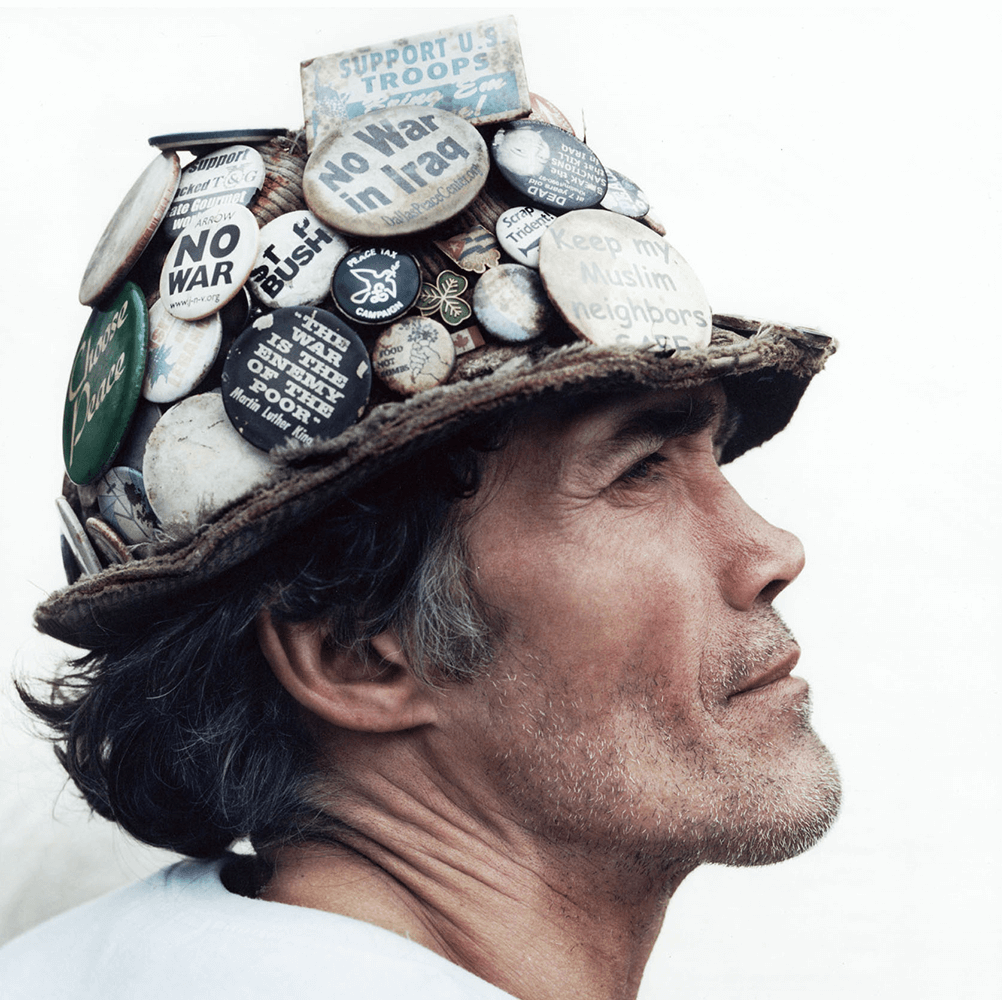
The well known anti-war campaigner Brian Haw. Photograph Andy hall
EDITORIAL: THE HORROR OF WAR
The most important thing at this point in time is to say that the mask of the global corporate capitalist empire centred in the United States has slipped. And we all see them nakedly for what they are: a small group of wealthy people, roughly concentrated in Europe and the United States, with their branches set up as little outposts in the rest of the world – against the majority, against the whole of Asia and the whole of Africa, and the whole of Latin America. There is no nice capitalism and there is no nicer imperialism.
Having said that, ordinary people like me and you live our lives. Most of these lives are full of neighbours and family, and friends, and work. We’re humans, not transhuman ghosts in machines. We are connected to nature. We stand on the earth. We don’t live in tin cans in space. And we are members of the same body called Gaia.
So when we talk about humane socialism, we don’t mean it in that aspirational sense where humanity is explained by some theory that is a parody of the physical sciences. Humane socialism encompasses the wissenschaft of humanity in its entirety: life as we know it; food, philosophy, love, art, music, friendship, solidarity, work and effort, excitement, enjoyment, contemplation. The humane socialism of our magazine is very much in harmony with, for example, the Quaker testimonies of peace, sustainability, truth, simplicity, and equality, and we emphasise the idea of the inotic – a word coined by Tony Hall. Inotic means the opposite of the exotic: wherever we go, no matter how different everything seems ultimately, we are the same human beings. And whether you or I am cleverer, stronger, prettier, taller, more efficient – whatever it may be – that does not give us privileges or rights over those of other people.
So the arch enemy of humane socialism is the inhumane, embodied in the many forms of Malthusianism and social Darwinism, the philosophy and language of the colonialist, the exploiter and the conqueror.
And if you need to ask why a humane socialist magazine is full of stories and poetry, and emotions, and commentary and discussion – it is because we are human before we are dogmatists. And therefore what we say can take many forms, and does. You don’t need a PhD to have a useful thought or an insight, or an appreciation of what is happening in the world. Not many novelists are nuclear physicists and yet people sit at their feet and ask them what they think of nuclear war.
We are all affected by what happens. And so, for example, we will all die, and therefore we all can have an opinion on euthanasia. We all must face death. We’re all affected by the destruction of the environment, by pollution and house prices and crime and exploitation, and ultimately by the mass murders conducted by terrorist states. Isn’t it obscene that Iranian schoolchildren die and all some people do in response is complain about increases in the price of petrol?
We will not apologise for the tone of this editorial when the President at the head of the pirate ship has just suggested he might destroy Iranian civilisation with nuclear bombs, potentially making the United States far more more evil than the German Fascists themselves. When it is revealed that US strategists are contemplating a nuclear exchange understanding full well that it would be at the price of 100 Holocausts, and they say so qitado de la pena.
So we offer you this issue of our magazine in this spirit: in the spirit of the celebration of the human, and in resolute opposition to the inhuman.
In this issue
We have been privileged to showcase the work of many valued and talented people.
We headline in April with an interview with Les Branson, the guerrilla filmmaker, interviewed by Paul Halas and associates, who is making waves in film festivals in Texas and further afield. Les has gathered around him an enthusiastic and hard-working team of actors and filmmakers, and on less than a shoestring produced three films that embody his love of the art.
We feature the photography of Inge Colijn, who must be one of the most talented travelling photographers alive in 2026. The colours of her photographs are astounding, the subjects and the stories she tells are powerful and the portraits endearing.
We have a diamond in our midst: Norman B. Schwartz. The sound editor who has worked on many famous films and is in the Hollywood Hall of Fame gives us his 17th article, this time on Darryl F. Zanuck. Mixing politics with observations and insights that you won’t get from anyone else, Norman brings precision of language and unequalled powers of analysis and observation to dissect the characters and politics of Hollywood.
Arun Kapil is a punk food poet about to revolutionise cooking in the West with his new book. He is the Spice King, and every week gives us his punk version of cooking. This week, he writes about foods with dubious reputations that are still enjoyed by many people. The word “Spam” features prominently.
The polemical and polarising Richard Steinhardt attempts to burst the bubble of Zack Polanski and Zohran Mamdani, calling them “hollow men”, and claims that Putin is implementing the Dzerzhinsky Solution for Ukraine: identifying, neutralising and integrating.
Phil Hall writes about euthanasia, angels, the Tarot, and imagining the future. His excuse is that he taught strategic foresight at university for two years, that he has used the Tarot for forty years, and that he has been intensly political since his parents were exiled from South Africa in 1963.
Poetry
We are graced by the presence of great poets and writers.
Roger Murphy, who just appeared in the International Colloquium of Poetry and Philosophy organised by Ulises Paniagua Olivares, introduces us to his reflections on the ode as a poetic form, gives us an example of one of his own odes, and discusses how difficult it was to write.
Dustin Pickering in Texas is a turbine of creativity – writing about politics, publishing books, appearing on podcasts, and writing poetry for our times. Here, he offers us his War Poems.
Hugo Giovanetti Viola, another influential, multifaceted artist whose work spans poetry, narrative, popular song, essays, theatre, film, journalism and cultural production – and who is also a guitar teacher – gives us three of his poems.
Tina Bexson, who has just flown back to the Sinai which she loves – a brave journalist of some standing who writes to defend her confrères and has been published in The Guardian, The Standard, The Times and many other publications – sends us a story about the thin human film between two cultures as they rub up against each other.
David Yip is cool, and he looks cool, but he’s not too cool for school. For the last seven months, he has given us episodes of his story: from being a boy who worked in a garden to help his mum and from working in Chinese restaurants alongside his father, to being a top chef and then catering manager up in that paradise called the Lake District. If you’ve read Anthony Bourdain, you’ll know the catering industry can be a rollercoaster ride.
From Poland, we have fantastic poets introduced to us by Richard Reisner: Jan Twardowski, Ewa Lipska, and Czesław Miłosz. Richard, who is an accomplished poet himself, fills in this gap for those of us who have only seen Miłosz on Polish postage stamps. Miłosz wrote poetry about the conflagration of war. Richard Reisner is the respected translator of Ewa Lipska’s work. Lipska writes metaphysical and social poetry. Richard’s third poet is Father Jan Twardowski – is he really underrated? I don’t see how. If you have bronze statues of the man placed in different parts of Poland, that means he’s popular, influential. Richard points out he was honest about the failings of the Church.
Carmen Nozal, the Spanish-Mexican poet, head of a writers’ school with an extremely distinguished career and winner of many prizes, who works as a coordinator at the National Museum of Arts in Mexico City, gives us her poems on water. Here is her poem:
INSTRUCTIONS FROM WATER LOOKING AT THE CEMETERY
Do not drink water from a plastic bottle:
for that you have your hands
with their lines of destiny perfectly traced
and their mounts to see Venus
fill the world with lovers
through which life passes in the form of organisms.
Do not drink water from a plastic bottle
because the water that comes from the clouds
likes to faint into the oceans,
returning to the ground after a long journey,
to seep into the brown earth that groans
for one drop, one tear, one crystalline river formed on the surface,
a nourishment that feeds the deep heart.
Any animal, even the beasts,
returns what it consumes,
in the form of secretions,
and even in its decomposition
adds to existence the joy of plants.
Do not drink water from a plastic bottle:
let it run over your palms,
rock it in the hollow of your hands, kiss it like a virgin bride
and do not disturb it, do not stain it, do not dishonour it,
do not fill it with sins built with your hands
and do not wash your hands with it
because one day it will abandon you.
Therefore you must not drink water from a plastic bottle.
We republish Sudeep Sen’s article Rabindranath Tagore as the Intimate Other in the light of his forthcoming participation in the International Colloquium of Poetry and Philosophy. It is an essay that has been read many times in many places, and it is worthy of rereading. Notably, Sudeep Sen was a friend of Raghu Rai, the famous photographer who has just died. Sen himself is a photographer and took a sequence of four different photographs of Rai in conversation with his friend, which reveal Rai’s warm and kind character beautifully. They talked together over a glass of whisky from an 18-year-old bottle of The Macallan, and Sen shares the poem he wrote in honour of one of his friend’s famous photographs.
The Writers’ Group (New Malden)
Last but not least, we have the Writers’ Group. Some of us have published our poems previously and some of us haven’t. We sit together in New Malden, a dozen of us, and read each other’s poems and discuss book projects and academic articles for journals. We even have a composer among us – the fantastic Laurentiu Gondiu. Last week we sat around listening to his latest composition, which he introduced like this: “These are my feelings as I walk around London.” Just tremendous!
So this week, we introduce the poems of Tom, John, Patrick, Phil and Karl. All of the poems are accomplished and life-affirming, the highlight being, of course, Patrick’s couplet:
“the early worm catches the bird.”
Unfortunately, this month Ars Notoria was not an early worm.
Discover more from Ars Notoria
Subscribe to get the latest posts sent to your email.