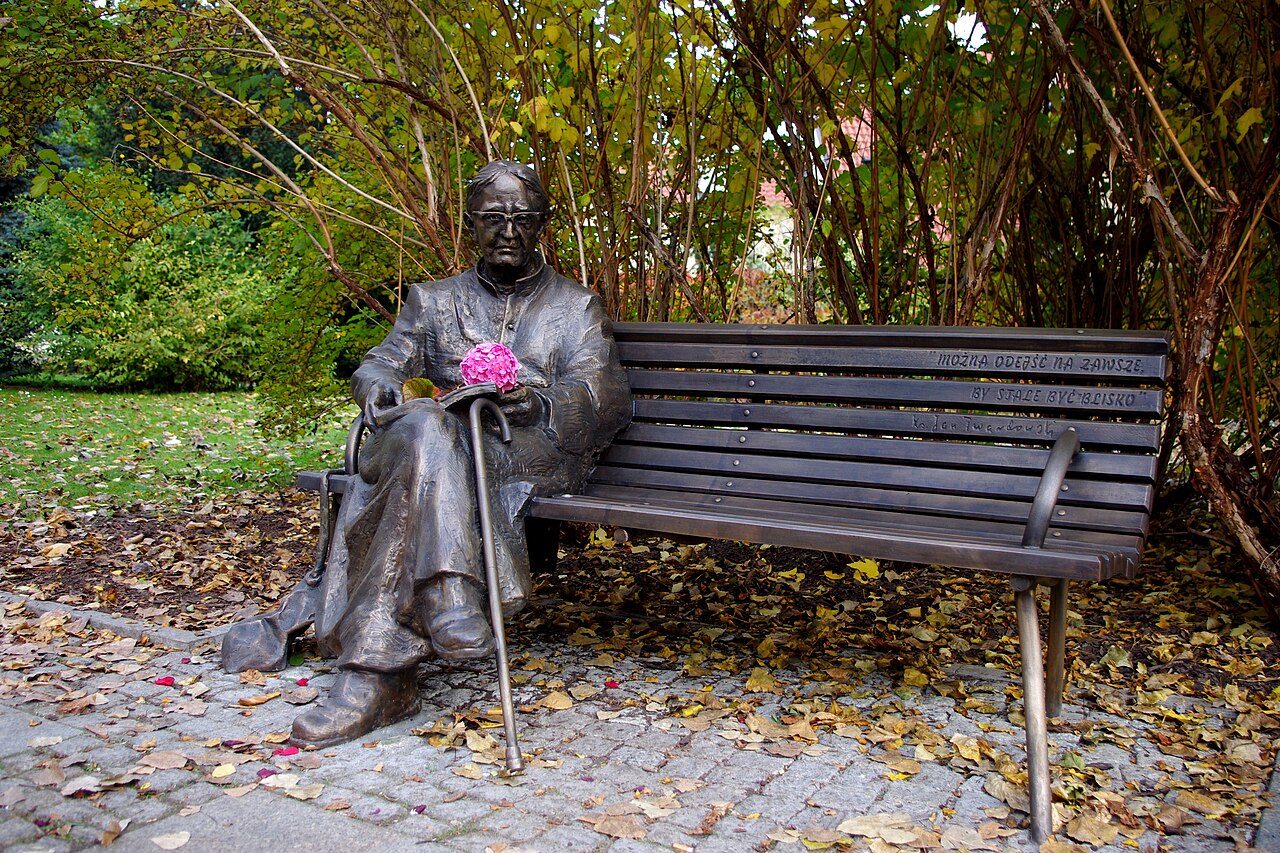
The Father Jan Twardowski Monument in Warsaw, Poland. Photograph Mateusz Opasiński
Here is a small selection from three Polish poets, as promised. Two are presented in a historical context: early poems by Miłosz that resonate to the conflagration of war. The first is the last of twenty poems in the ‘World’ cycle, which needs to be seen as a response, or indeed a refuge, by the poet to classicism in painting the Lithuanian country estate of his childhood. It could also be said to be a direct negation of the ‘Hurra Romantics’, led at that time by the poet Baczyński.
The second poet, Ewa Lipska, in her earlier poem, presents an already present ‘metaphysical’ turn that will continue to develop in her later work. Her next poem, brushed on the canvas of soon-to-be martial law in communist Poland, showcases Lipska’s documentation of society and its workings.
The third poet, Father Jan Twardowski, much underrated by literary critics, came to play an important role in raising interest among ‘ordinary’ folk in poetry. Among men of the cloth he became the most important and influential poet of his day throughout the post-war years and into the late 1990s. One important aspect of his poetry, especially in his later work, is his ability to chastise the worst of the Church in his own inimitable way.
Ryszard Reisner, Translator
Jan Twardowski
WIERSZE
POEMS (1959)
They all crave for bread to beget bread,
paralytic complete in Lourdes is bathing,
even the bishop to heaven wants to head,
thus without sin, in comfort, so stately.
But I continue to fall head down first,
like a jam filled jar I burst on the stairs.
ZNAKI UFNOŚCI
SIGNS OF FAITH (1970)
Do Not/Nie
Do not sprinkle sugar over religion
do not erase it with a rubber
do not dress angles flying above war in rosy rags
do not refer the faithful to pipe-like remarks
I do not come for comfort as for a bowl of soup
but wanted at last to rest my head
on the rock of faith
Nothing More/Nic Więcej
He wrote My God but crossed it out, for after all he had
as much my in mind, as I am a selfish piglet
he wrote Humanity’s God but bit his tongue for he still
recalled angels and stones similar in snow to rabbits
finally he wrote simply God. Nothing more.
Still he wrote too much.
Niebieskie Okulary I Inne Zbiory (1980)
Heavenly Spectacles And Other Collections
In Heaven/W Niebie
It’s necessary to pass Saint Peter with the heavy key
Agnes with lamb snuggled to her face
Therese who still coughs
for she froze in the convent
it’s necessary to push past through the martyrs
standing with crosses and creating a traffic jam
next to the humble stork
next to Agatha who offers salt
next to Saint Francis with the wolf
(removes his muzzle so he can yawn)
next to Saint Stanisław with an exercise book for Polish
and finally I see my mother
in a house not burnt down
sowing a button that constantly went missing
How much heaven needs to be passed to find her
A Tour Around Hell/Oprowadzenie Po Piekle
Here solitary confinement
not a thing helped
now had a square halo
stubbornly tried for a round one
and there lower down
parish priest is yelping
built a church
like the Warsaw Palace of Culture with a cross
SUMIENIE RUSZYŁO I INNE ZBIORY (1990)
CONSCIENCE TWIGGED AND OTHER COLLECTIONS
To Father Baka/Do Księdza Baki
Knock knock at heaven.
Who is it ?
It’s me.
Night.
The saints already sleep on heavenly lawn
For his humour and small coffin I’d sure
love to kiss Father Baka’s dear paw.
More Or Less/Mniej Więcej
Oh these words – more or less
they repeat them out of habit
off-the-cuff
slap-dash
pass them on like ungainly hands
who’ll understand
who’ll explain
that less means more
SPÓŻNIONE KUKANIE
A BELATED CUCKOO CALL (1996)
Sunt Lacrimae Rerum Ut Mentem Mortalia Tangunt
Now alone
a thimble
a soup bowl and dinner plate
a small mirror from merry grandmother
three silver forks
a cock out of red clay
photographs with a heart condition
an M.A and Post-Doc.
like peacocks on a grave
Living shards left behind do long for you.
Ewa Lipska

Ewa Lipska. Photograph Krzysztof Poboży
CZWARTY ZBIÓR WIERSZY (1974)
COLLECTED POEMS IV
HANDS
Ones
we offer
for dismissal.
Ones
offered to us
as if hands.
Ones
we firmly hold
our head with.
All
that give us
a free hand
in making decisions.
Ones
that slip out
of hands.
Hands
that can always be relied on
like those fallen.
STREFA OGRANICZONEGO POSTOJU (1990)
LIMITED PARKING ZONE
I WORK HERE
I work here. In the east of Europe.
Surrounded by dogs. Small and awkward.
People sad or drunken.
Or tragic like in August Strindberg.
On the desk a poem ration.
A glove. Letters. In the window ink.
Middle of the room an armchair
from Tutenkhamen’s tomb.
Paper is still breathing
but heavily. With nitroglycerine.
My time. My body. My life.
Everything is disposable
just like a paper dress or a serviette.
Certain only the shadow in room corner.
Growing larger by the years –
a black taxi.
CZESŁAW MIŁOSZ

Litewski znaczek pocztowy wydany z okazji 100. rocznicy urodzin Miłosza.
Photograph Nieznany
ŚWIAT POEMA NAIWNE (1943)
THE WORLD – A NAIVE POEM CYCLE
THE SUN/SŁOŃCE XX
The sun does all the colours hold –
it has them all, not just the one.
Yes, all Earth is as if a poem told
and above the artist is set by the sun.
Should you wish to paint the world so bright,
pray look not straight at the sun, learn –
what you remember and see, you lose sight
and only tear-laid eyes stay that burn.
Let him kneel unto grass, his face now low
and look at Earth’s light echoed by skies.
There shall he find all we have cast to go:
the stars and roses, sunset and sunrise.
OCALENIE
RESCUE (1945)
Fleeing the City/Ucieczka
When we had to leave the burning city
on the first path in the field, looking back,
I said: ‘Oh may the grass grow over our tracks,
oh may the shouting prophets fall silent in the fires,
oh may the dead tell the dead what took place –
we are fated to beget anew, a fierce tribe,
free from evil and good fortune that lay in waiting.
Go then you and I’.
And a sword of fire broached the earth.
Richard J. Reisner is a Polish-Australian poet of Jewish extraction, whose personal history is in part interwoven with his literary vocation, a legacy that informs his work. His parents, as others, found themselves captive in the Warsaw Ghetto and managed to escape, using Aryan IDs. Towards the end of the Ghetto Uprising his father, fluent in German, worked in the Nazi-controlled field hospital outside Warsaw, in charge of materials provisions. After a period in Melbourne, where Richard worked in the Spielberg Interview Documentation project at the Holocaust Museum and organised literary evenings, he returned to Poland on a translation grant.
As a translator and scholar, Reisner has built an extensive body of work. He has edited significant bilingual anthologies, such as The City of Home, an English-Polish collection of Australian poetry co-edited with Thomas Shapcott. His translations into English encompass major Polish literary figures, including Ewa Lipska, Zbigniew Herbert, Tadeusz Różewicz, and Czesław Miłosz’s cycle Swiat. Poema naiwne (The World). His collaborative projects are wide-ranging, from theatre translations to the multilingual Songs on Canvas project based on Marek Grechuta’s interpretations of paintings, and more recent work translating Russian poets like Regina Derieva.
Reisner is currently completing several major projects: a Polish translation of selected works by Australian poet Les Murray (A Grinful of Dynamite), an English translation of aphorisms by Ludmila Petrushevskaya, and a volume of his own poetry titled Letters to the World.
Discover more from Ars Notoria
Subscribe to get the latest posts sent to your email.

You must be logged in to post a comment.