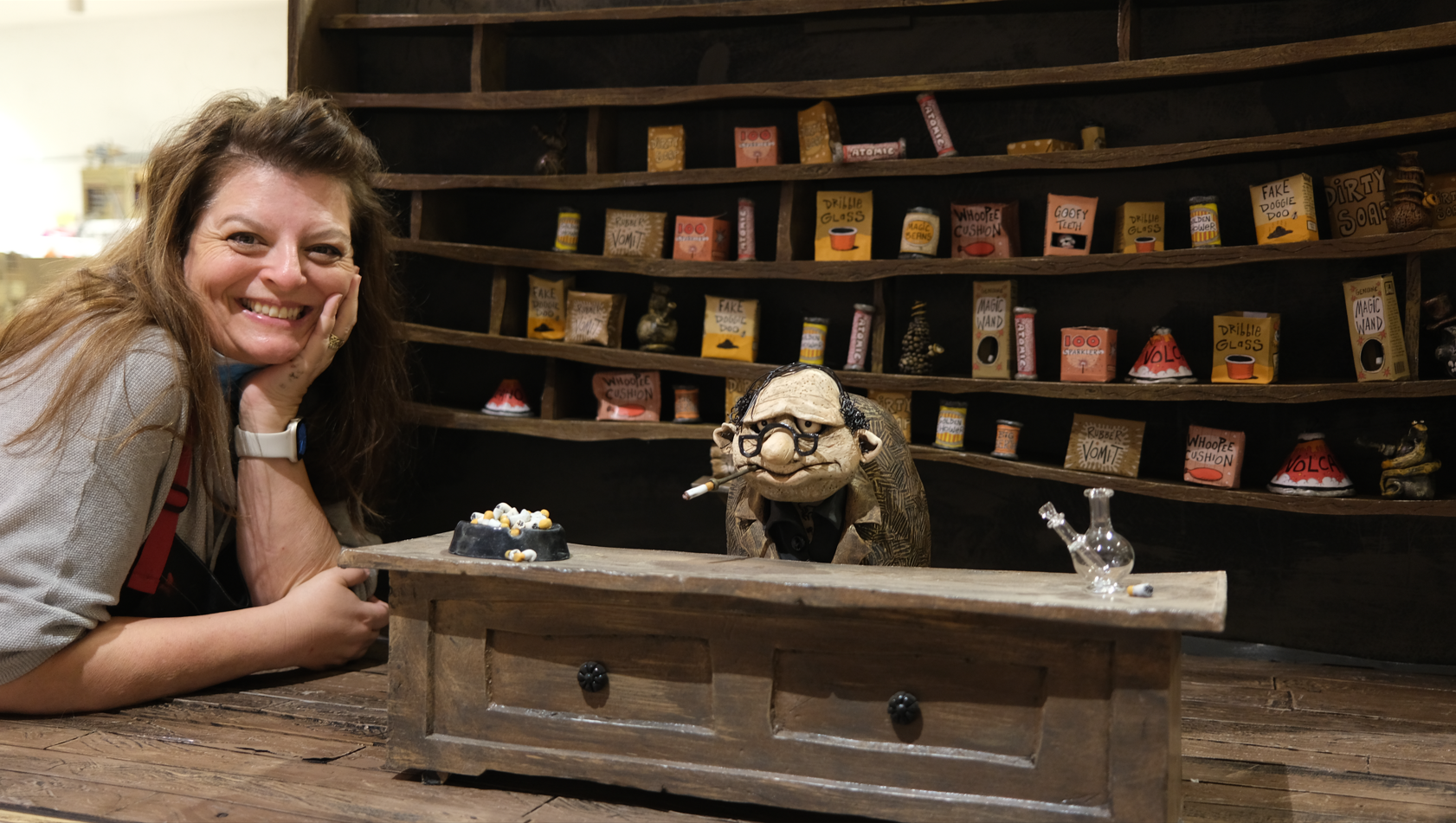
On the set of Memoir of a Snail. Still by kind permission of ArenaMedia
INTERVIEWED BY PAUL HALAS & PHIL HALL
Kerry Drumm has variously been an animator, designer, illustrator, film archivist, production coordinator, screenwriter, playwright and children’s book author… in fact when I first familiarised myself with her body of work I thought, “oh my, there’s another bloody polymath.” She has a long list of credits and awards, and is especially known for her writing about the lives of army families, particularly the wives and children, and creating intimate and compassionate depictions of people when feelings become too overwhelming to bear. To quote her, a big theme of her writing is about, “what are people unable to say, and what happens when they can no longer avoid saying it.”
Paul Halas: Hi Kerry. Although it’s the first time we’ve met, I think we have a very old, if tenuous, connection.
Kerry Drumm: Yes, I know your sister Vivien from way back, when I was an animation student, and did some archiving at Halas and Batchelor Animation, your parents’ company.
Paul: As I understand it you were involved in animation well before you began writing. Maybe we could start off with some background, because there’s an Army background to much of your writing. Do you come from an army family?
Kerry: No, I married into the RAF. My husband was in for 23 years, and we moved around a fair bit because of that. Cyprus, Germany, and various places around the UK. I’m a military wife.
Paul: You’ve written award-winning films and plays about military families. You described how you’re a quiet and observant person, certainly as a kid. Would you say your writing is based on personal experience, and on what you’ve observed of those around you?
Kerry: Absolutely. I think for a lot of writing that’s where you find the strength: in what’s familiar. Because it’s familiar to you, it’s probably familiar to those watching or reading as well. I naturally gravitate towards that style of writing and observing.
I was very quiet as a child, the eldest of three, always the most well-behaved, which meant I had to watch a lot. And then I was badly dyslexic as a kid, although that was undiagnosed in the 1970s, so I’d just draw and make sketchbooks and listen to what was going on around me. It’s still the same, although I’m 56; I still draw and listen. It’s just natural for me to be like that.

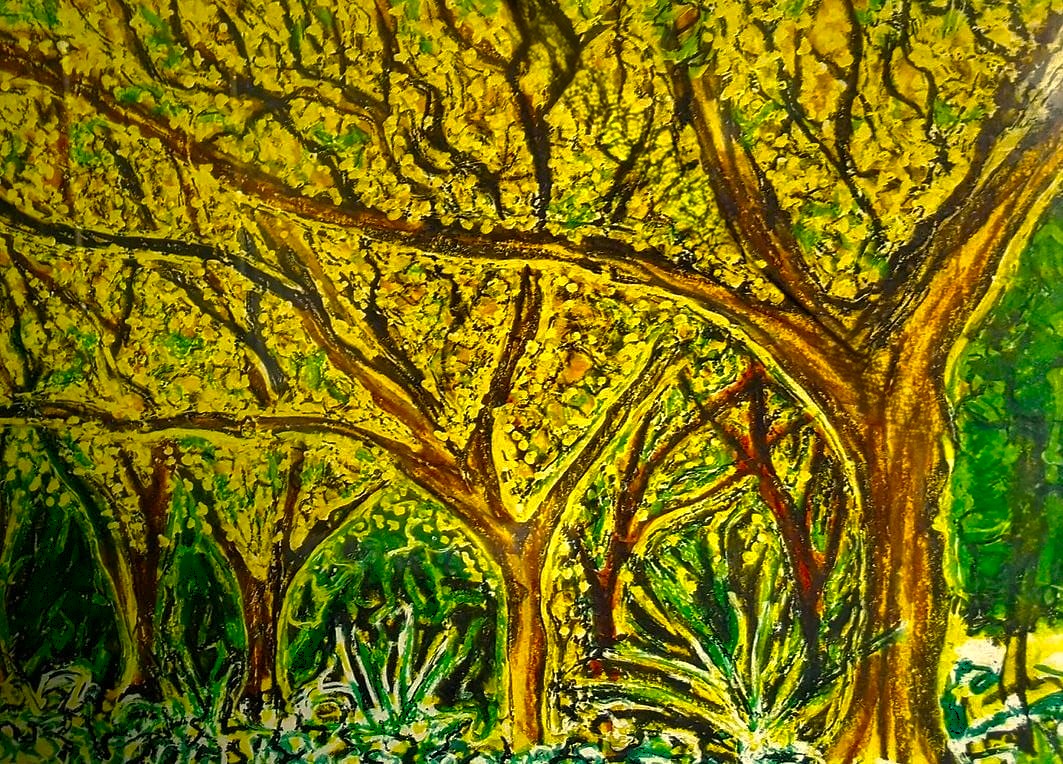
Illustration by Kerry Drumm
Paul: I’m fascinated by that, because I’m mildly dyslexic, and have three sons who are also dyslexic to a degree. It can affect your life choices. I’m interested in how you made the journey from doing something very visual, physical almost, to verbal. From visual storytelling to storytelling with words.
Phil Hall: Can I backtrack, just for a minute, and go back to the beginning, to the work you did before you got to the writing. You call them doodles. They look like the best kind of children’s book illustrations. I can imagine then being used for Orlando the Cat, or The General who refused to Fight, those kinds of beautiful picture books. I just wonder if children’s illustrations and books are important to you in some way.

Illustration by Kerry Drumm
Kerry: I think so. I used to take part in the Glenda Jackson Youth Theatre, and was always very interested in production design. Then I married into the military, moved around, and was always doing character portraits for people that I worked with. We were posted from Germany to Hampshire, and an officer’s wife told me there was a big art college there.
My art teacher at school had told me to go to art college, but no, I wanted to go onto a YTS (Youth Training Scheme). It was the 80s, and this child was going to get £25 per week because I’d had enough of education.
So when we moved to Hampshire I thought I’d look at the college. At the time I wanted to be a children’s book illustrator, but they didn’t teach illustration there – however they did have a BA in animation and storytelling. I was interested in storytelling, so I went into animation more for the storytelling than the animation itself. I was just drawn to storytelling somehow. I didn’t think I’d be involved with words, because I was diagnosed as being dyslexic during the first year of my degree. But actually, to write a script, it’s probably the easiest thing to do being dyslexic. You don’t have to be too heavy on the words (even although it’s a written document, it’s a method of visual storytelling. But it came about by accident. If they’d had a children’s book illustration course I would’ve gone for that. I’ve been told a lot that I should be a storyboard artist or illustrate children’s books. Hopefully it’ll come together next year; I’ve been working on one for four years.
Paul: From early on I’d assumed I’d follow the family tradition of creating images of some kind… but preferably comics and graphic novels. When I discovered I had no talent for it, I realised my only route into that world was through words… writing stories. It didn’t come easily, or certainly not at first. I imagine you had a rather smoother transition.
Kerry: It was okay to begin with, and in a way liberating. I was 15 when I left school, and it took me until the age of 30 to get back into education… simply thanks to a throwaway comment by an officer’s wife. Otherwise, I don’t know what would’ve happened. I like to think I would’ve got back into it under my own steam.
Phil: Do you recognise yourself in Educating Rita a bit, in the sense that you came from a working-class background, and then found yourself in education, and you realised that you were as intelligent, brilliant, or more so, than those around you?
Kerry: I’d say yes, because I was in a class of 18- and 19-year-olds who’d just come from college, and were going out drinking every night. That wasn’t for me, hanging about the students’ union etc. Also my accent probably set me apart a little. But I’m still good friends with some of the group from back then, so it did make a lasting impression on me. Here’s the thing: with creative degrees, if you have a bit of life experience, you have bigger stories to tell. I wasn’t so focussed on the look of things, animation-wise, it was more about the stories, about what I wanted to say, because I had a lot to say by the time I was 30.
Paul: Did you find that learning animation helped you with pacing, helped you with story syntax, helped you give form to your ideas? I’m not talking about content, but how you form your content into a cohesive whole?
Kerry: I think so, because you can’t rush into it; you’re restricted to a certain pace with animation. The thesis part of my course I found very frustrating and difficult. With my dissertations and written work I was failing miserably, but at the same time I was excelling and getting firsts in my practice. So I had to work out how to balance the two sides of it. It’s not just the animation that gets you your degree, you have to be academic too, and a lot of creative people find that incredibly difficult. In the end, I just went at my own pace.
Phil: For example, if you’re going to be a teacher – I’m a teacher by the way – if you’re a teacher and you do a PhD, you immediately stop being a teacher and become an academic. Whereas if you do a doctorate in education, you’re deepening your practice. So in a sense if you do a PhD you’re moving into a managerial, academic path. Is that the one you chose?
Kerry: When I was offered the PhD course I thought it was ridiculous. Why would I want to go and do a PhD? I’d just spent four years having a big moan about writing about animation. So I was offered a practice PhD, in which 40% was theory and the rest practice. So I went for it. Also it was linked to Halas and Batchelor, so I was able to use my experience working in the archives and the Halas and Batchelor Collection. My PhD was on public information films from the Second World War. I knew a lot about that, and was going to make an information film. It was still a struggle, actually, and if anyone asked me now about doing a PhD I’d answer they should really give it a lot of thought.no.
Phil: I remember being forced to watch Halas and Batchelor’s Animal Farm when I was attending an American school as a child. It was clearly anti-Soviet propaganda. They made a great many wonderful public information films, such as Charlie’s March of Time, and then you have Animal Farm, that was shoved down the throats of every child in the Western World. On the one had you have you have a work prompted by the CIA, and on the other a body of highly socially aware work. There appears to be a dichotomy there.
Kerry: During the Second World War Halas and Batchelor were paid to make films by the government, the Ministry of Information, on subjects that were dictated by the government. Very much about helping on the Home Front. It was all about morale, helping families, make do and mend, grow your own vegetables… I think their wartime films are fantastic, very motivating, although they probably would’ve like to have gone deeper and darker. But I love those wartime films; they’re fabulous. And you really see Joy Batchelor in them.
Paul: Joy Batchelor has her stamp on a lot of that work, and the studio made a few more public information films, right up to 1970. But regarding Animal Farm, that was a project the Halases had been interested in for many years, without having the means to make it. In order to achieve that, they accepted American backing… and the strings that came with it. I’d actually describe my parents as having been soft-left, but they compromised in order to create Europe’s first animated feature film.
Phil: So, looking back at past work, such as your participation in Memoir of a Snail (writer/director Adam Elliot), it was pretty dark. And it was also very, very good. And Paul and I were saying it appeared to resonate with many of the themes in your own projects. Did you find that, or was Adam Elliot’s work something different?
Kerry: I first met Adam when I was a student at the Surrey Institute for Art and Design. I’d seen his trilogy of short films, and our friendship grew from that. He’s from Melbourne and I’m from the Northwest of England, so I think we connect a lot.
Years later, when my husband and I decided to relocate to Australia, he told me there would always be a job with him. So then eventually – it takes forever to raise funding for animation – I read his script for Memoir. He’s a really fantastic storyteller, and we were both into stop motion animation. So I knew I was going to have the best time on Memoir of a Snail. I worked on props for pre-production and then set dressing, with some additional animation. I was very lucky to work with one of my best friends, and I’m super proud of him and the film, and everyone who world on Snail. I believe he’s one of the best writers out there.
Paul: There certainly appear to be similarities between yours and his writing.
Kerry: We’re very supportive of one another’s writing. He gets my writing and I get his. That’s why I was drawn to his films when I was a student. His short films are little monologues, the kind of thing I love to write.
Paul: What started you writing for theatre and scripts? What drew you away from animation? Did you always want to do that kind of work, and reached a point where you realised you were ready to go ahead and do it?
Kerry: Yes. I knew my area was the people I know, from my military family background. I didn’t know how to write a script, so I had to learn… it’s not something you’re taught in an animation degree. It should be, but it’s not. I had to think how I was going to tell my story of military families. And why? To Whom? Why the need to get it all down on paper? I really don’t know what made me do it; I just kind of fell into it. And I was given a lot of encouragement during all of this.
Phil: Regarding your series Incoming: Words of War and Incoming: The Wives, have you had many interesting responses from military wives or people in the military?

Incoming – Words Of War. Still by kind permission of Kerry Drumm and Emma Hunt
Kerry: A lot. From both wives and soldiers. I also went and spent some time on a military base in Australia, and the wives said, “Tell our stories. No one tells our stories.” So yes, there has been really positive feedback, from both military and non-military people.
Phil: There are things you articulate that are very difficult. Like where a son has died; grief is incredibly difficult to articulate. Being able to write things that that allow people to speak about those things; to see on a screen, or in a play, their own feelings being expressed somehow. Is that part of your philosophy of writing? Following your PhD etc., do you believe you’re allowing people to articulate thoughts and emotions on subjects that haven’t been explored sufficiently?
Kerry: I think so. And I write about subjects that are universal as well. I just write about what I know, and how I feel, from the heart, very honestly. The grief storyline in Tanked is, for many families, a constant worry. Whether it knocks on your door or not, it’s always there. So that’s in the military, but actually I think it’s universal. It’s something that’s always there. That’s what I try to deal with: how do you keep it together when it’s all falling apart?

Tanked. Photograph by kind permission of Kerry Drumm
Paul: How do you express the unbearable, especially when it’s been buried for years? I’m thinking about your play Strawberry, which deals with deep family trauma, and the rocky journey towards to some kind of a resolution.
Kerry: With Strawberry a friend and mentor, Hayley McKenzie, a script editor, suggested I write a play. At first I thought you have to be very well edcuated to write a play, but thanks to her encouragement, I gave it a try.
Strawberry is very personal. It’s not that what happened to the main character happened to me, but these are all themes I’m intimately familiar with, and I drew on a lot of what I felt while growing up.
When I was at the Glenda Jackson Youth Theatre they weren’t really doing a lot that directly involved kids, and I wanted to see something with a fifteen-year-old. So, I wrote Strawberry, because I wanted to give a fifteen-year-old girl a role.

Strawberry. Photograph by kind permission of Williamstown Little Theatre
Paul: The split set in Strawberry is very imaginative, two sitting rooms in separate buildings sharing the same stage. And the best friend, whose lines are only seen as text messages. A very contemporary way of keeping the narrative together, darting back and forth so quickly.
Kerry: Much of life takes place on a sofa! People get divorced, are conceived, fall in love, get proposed to… I wanted a setting with one sofa straddling both separate areas of the stage. That, in the script, is the focal point of the production, but what happens thereafter is up to the director.
In the rehearsal, every time Shelby’s text messages came on there was a big roar of laughter. Shelby was Tabitha’s best friend without her actually being there, just sending those text messages. It’s Strawberry, because I wanted a fifteen-year-old to have a really good, substantial role.
Paul: In many plays too much scene changing breaks up the flow, and you rather lose the narrative.
Kerry: Especially when you want to keep the pace. My play Brothers was very much the same. How to tell the story between two boys over 20 years, without scene changes, in one hour?

Brothers. Photograph by kind permission of Little Red Fox Productions
With theatre you’ve got to trust your audience are going to “get” it. They’re going to be taken on a rollercoaster with those two boys – but they’re going to be all right. And with Strawberry, people were walking out of the theatre in floods of tears… They’d loved it, and I wasn’t expecting that effect.

Strawberry. Photograph by kind permission of Williamstown Little Theatre
Paul: A general theatrical question: how much do you “tune” a production based on audience reaction during rehearsal? Do you stick to your guns, or take a big spanner to it?
Kerry: I’m a big believer in workshops… a cooperative effort. We workshopped Strawberry and invited a lot of people I trusted to rehearsals, and took their advice. With Brothers we were in lockdown due to Covid, so we went online and practiced via Zoom etc. Actually, with that, we didn’t start with a script as such, it grew from an idea I’d had and we workshopped it all the way.

‘Tanked’ Reading. Photograph by kind permission of Kerry Drumm
Phil: So, taking someone like Shakespeare, and people say he’s the greatest writer, actually he’s not the greatest writer, he’s the greatest theatre writer. He’s not the greatest writer per-se; he didn’t write novels. What’s your intuition about him? Do you think he workshopped his plays? Do you think they tried them out and the actors gave him ideas?
Kerry: I rather think so. I don’t know anyone who can write things straight away and go out and be brilliant. I don’t think it’s possible. Sometimes I think a character’s brilliant, but in front of an audience it doesn’t work. You have to, as they say, kill your darlings. You have to workshop and try it out.
Paul: Collective feedback is obviously a big part of the process. Have you ever tried your hand at writing novels? It’s a process where you’re very much on your own, unless you’re very lucky or well-known and have a guardian angel editor sitting on your shoulder and giving you prompts.
Kerry: It had occurred to me, but no. I’m not a massive book reader, and I think a novel is just too terrifying – which probably comes back to my dyslexia as well. One thing I learnt in my girls’ school on the Wirral was touch typing. It’s immensely useful when scripting, because I can get down thoughts and dialogue very quickly. And because my dyslexic memory isn’t so good, when writing a novel I probably wouldn’t remember what I’d written on the previous page. In a script you just get across what’s happening and write in your dialogue. It’s a lot easier. A book? No way.
Paul: Your time in Australia. Was that due to your husband’s army career?
Kerry: No, he’d retired from the RAF, and we’d always aimed to emigrate once he quit, so we decided, “let’s go backpacking.” (Actually I’d been backpacking in my early twenties.) I’ve got family in Australia, and Steven had finished his 23 years, so we got our visas and moved to Melbourne for 14 years.
Phil: Apparently Melbourne’s a really nice place. Not as “happening” as Sydney, but very pleasant.
Kerry: It is. When I worked at Aardman Animation I lived in Bristol for a bit; Melbourne was a bit like a cross between Bristol and Manchester. It had a nice vibe to it. There were proper seasons, and lots of arts and culture and film, and you could get around on the tram, we just loved it.
Phil: And you worked in Australia – had to start afresh.
Kerry: Started again. I was still trying to finish my PhD when we got to Melbourne, and it took a lot of my time, but also I worked as a production coordinator on the animation short The Gallant Captain. The director of Gallant, Katrina Mathers, had read my feature film script Tanked, and when I was invited to film a three minute script sample, Kat offered to direct and play the role of Jackie (Kat is an actress). The sample was seen by Tony Wright and its director mentioned that she’d read my script Tanked, and wanted to do it. , a producer, and they optioned the feature and we worked to develop it into a TV series.
Phil: Going back to your pictures, they’re really beautiful, very particular to you – they look like fine illustrations. It seems a shame they’re just doodles, because they could be animations or book illustrations. I could just imagine a short film with your characters.
Kerry: I’m currently writing and illustrating a children’s book that could potentially make an animated film. It’s called When Philip came to Stay… by Accident, and it’s about a little girl who’s miffed at not being able to go on holiday until Philip, a planet-trotting travel guide writer lands in her garden. While his spaceship’s navigation system reboots, she shows the alien all the interesting things in her town, and the time he leaves again, she realises that where she lives is actually pretty great.

When Philip came to Stay… by Accident. Illustration Kerry Drumm
Paul: It sounds as if it would make a great animated film.
Kerry: At the moment it’s a book. I’ve been working out my layout and how many words I’ve got… It’s like a bit like the screenwriting, learning a whole new language. Word count, page count, who’s your audience… I can’t just charge in and make the book I want to make. There are guidelines to it. Anyway, it’s going to be my 2027 project, once I’ve finished the feature film I’m on at the moment.
Paul: Tell us more!
Kerry: It’s called Milk Bottle Tops, a period drama based on a true story, about miners’ wives setting up a football team during the 1921 miners’ strike to help fund soup kitchens. It’s a story about woman coming out of the kitchen, about community, friendships, opposition, and its a love story with the film’s illiterate protagonist seeking hope, finding her voice, and taking a stand… no matter the cost. Very northern! So it’s a bit like The Full Monty, only with football instead of stripping. The main character is suffering from PTSD from the Frist World War, so there’s a lot of darkness there… but humour too.
Phil: Have you ever had any offers from Hollywood, or would you even consider such a thing? What if someone came along and wanted to finance one of your scripts, but demanded major changes?
Kerry: I’m very much a people person and love collaborating, and I’m not at all precious about my work. If such a thing happened I certainly wouldn’t be put off initially. It’s so difficult to get your own projects off the ground; I’d certainly want to talk about it.
Paul: When do you see your current project finishing? Or are there never finishing lines?
Kerry: It’s pretty well finished. I have to get it back to the producers. And I have a good few projects going out this year. A TV series called Yokry that’s being read, meetings on another TV series in Australia… But Milk Bottle Tops, is my first feature since Tanked, it’s a gorgeous story and it’s scheduled to go out by the end of autumn.
Phil: It seems to me you’re on the verge of global fame, something really important. We’re lucky to have been able to talk to you now before you’re too busy!
Kerry: I have a short film in production that has Ryan Moloney in it, so hopefully that’ll open more doors. You keep putting content out there, no one’s just going to come knocking on your door if you’re not making yourself visible. So, I keep writing what I want to write, and drawing what I want to draw. It seems to work.
Paul: We completely agree with that. A great footnote to our talk!
Paul and Phil: Thank you Kerry!
Paul Halas, the Arts and Lifestyle Editor of Ars Notoria and co-founder of AN Editions, is a writer of Jewish heritage whose escape from 1970s hippidom was the discovery that he could invent stories. He spent forty years contributing to various Disney magazines and books, as well as a variety of non-Disney comics, books and animated films.
Phil Hall was born in South Africa into an ANC family with British, French, Austrian, and German roots. He studied Russian and Spanish literature, politics, and economics. Phil has lived and worked in Spain, the USSR, Mexico and the Gulf. Returning to London during the pandemic, he co-founded the Humane Socialist magazine, Ars Notoria (the Art of the Noteworthy) and the micropublisher, AN Editions.
Discover more from Ars Notoria
Subscribe to get the latest posts sent to your email.

You must be logged in to post a comment.