
Tejidos Songhay [Mali] [Colección Fondo Kati].
by Ismaël Diadié Haïdara
To Paco Montañés, painter
Theme and Variations – I
1
Tebræ are two-verse poems (with 6 feet in the first verse and 8 in the second), shorter than haikus, initially created by Hasaniya-speaking women of the Sahara Desert. They are like objects whose structure repeats at different scales and dimensions. They thus meet the definition of a fractal. The two-verse structure is reproduced in self-similar, recursive texts following a “fractal” pattern. The structure reproduces at various scales, forming, as it extends, poems as ever-larger structures of the same modular poetic forms. The tebræ, as fractal poetry, are constituted recursively, as if they were Chinese boxes, following the same patterns of construction at different scales.
2
The first systematic study of fractal objects was carried out by the mathematician Benoît Mandelbrot in Les Objets fractals: forme, hasard et dimension (1st ed., 1975) [Les Objets fractals: forme, hasard et dimension suivi de Survol du langage fractal, 1989, 3rd ed., 4th ed., 1995]. This study developed ideas that he had already set forth in 1967 in a celebrated article, published on May 5 of that year in the journal Science, titled “How Long Is the Coast of Britain? Statistical Self-Similarity and Fractional Dimension” [1], although the term “fractal” does not yet appear therein. Subsequently, he called these objects with their rough, porous, or fragmented forms, fractals and, from there, developed a new geometry of nature and chaos.

Benoît Mandelbrot developed a geometry of nature and chaos. Non-integer Multibrot. Design by Nmondal
3
Fractals are characterised by the repetition of similar patterns at increasingly smaller or larger scales. Fractals have become a new tool for modelling in biology, geology, and other natural sciences. Fractal geometry has also become one of the most fascinating frontiers between mathematics and information technology, and these patterns can be observed in many of the recursive spiral patterns produced by computer-generated graphics.
Anthropologists have observed that the patterns produced in different cultures can be characterised by specific design themes. In America, for example, we often see cities arranged in a grid of straight streets and right-angled corners. In contrast, traditional African settlements tend to use more fractal structures: circles within circles with circular dwellings, or rectangular walls enclosing increasingly smaller, similar rectangles, and streets where wide avenues branch into small paths with striking geometric repetition. These African fractal forms are not limited to architecture; Ron Eglash, in African Fractals: Modern Computing and Indigenous Design [2], made the generalisation that “recursive patterns resonate in many disparate African designs and knowledge systems.”

Fibonacci word gaskett. Design Prokofiev
4
Pre-Islamic and pre-colonial African architecture offers the same fractal elements. As Ron Eglash observed, if Africans used circular houses in their architecture, then they used circles within the circular houses. If they used rectangles, then one saw rectangles within the rectangular house. These buildings are separated by wide avenues that divide into narrow, smaller streets that branch into tiny paths. From a modern Western perspective, this may appear chaotic, but from a mathematical point of view, it is the ordering accounted for by Chaos Theory: fractal geometry. A well-known example of this well-organised chaos is the city of Labbezanga, in Mali. Here is a smaller iteration of the same pattering.

Photo by Alex Gamaliel on Pexels.com
5
The same fractal objects found in urban structures can be seen in African fabrics from Timbuktu and the rest of Africa.


Charka al-Cilla [Peul fabric, Macina Region] [Fondo Kati Collection].
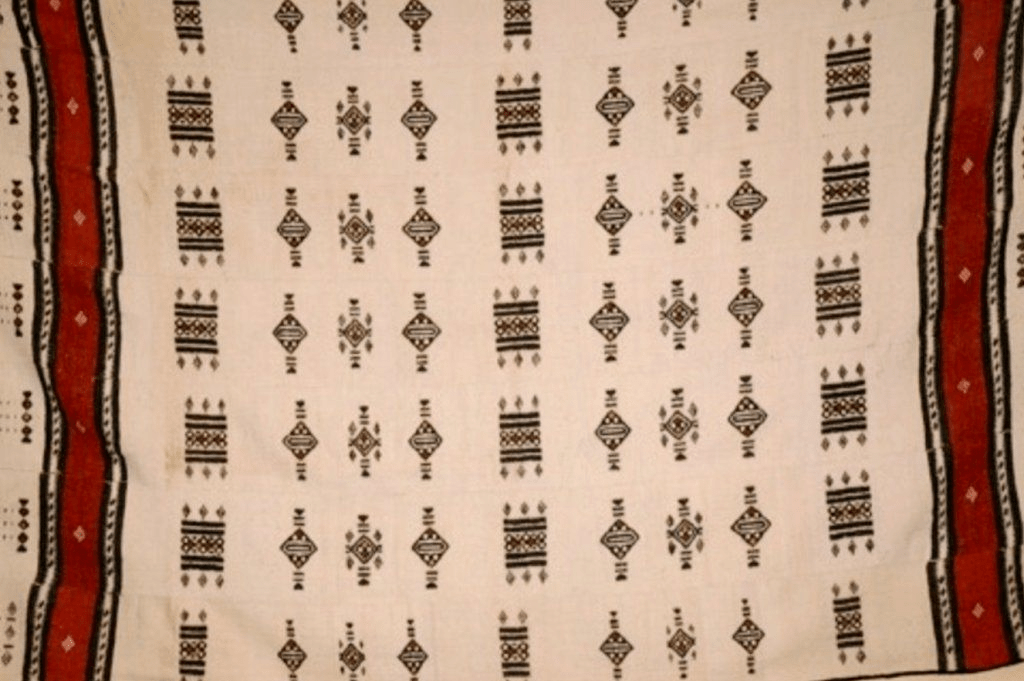
Charka al-Cilla [Peul fabric, Macina Region] [Fondo Kati Collection].
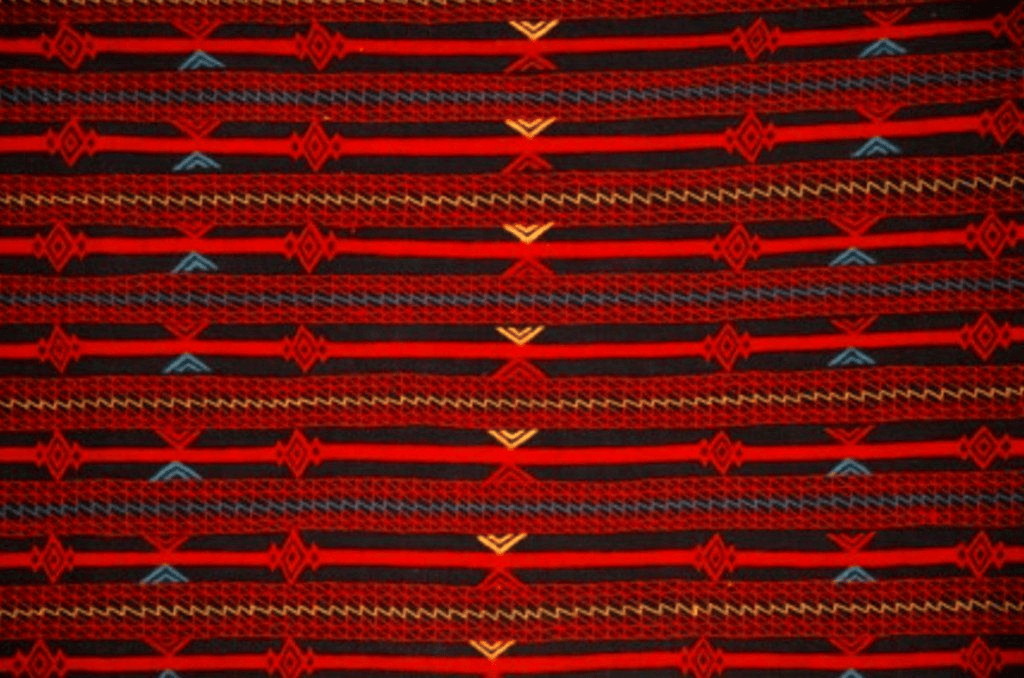
Dogon Mantle [Fondo Kati Collection].

Songhay Fabrics [Fondo Kati Collection].

Songhay Fabrics [Fondo Kati Collection].
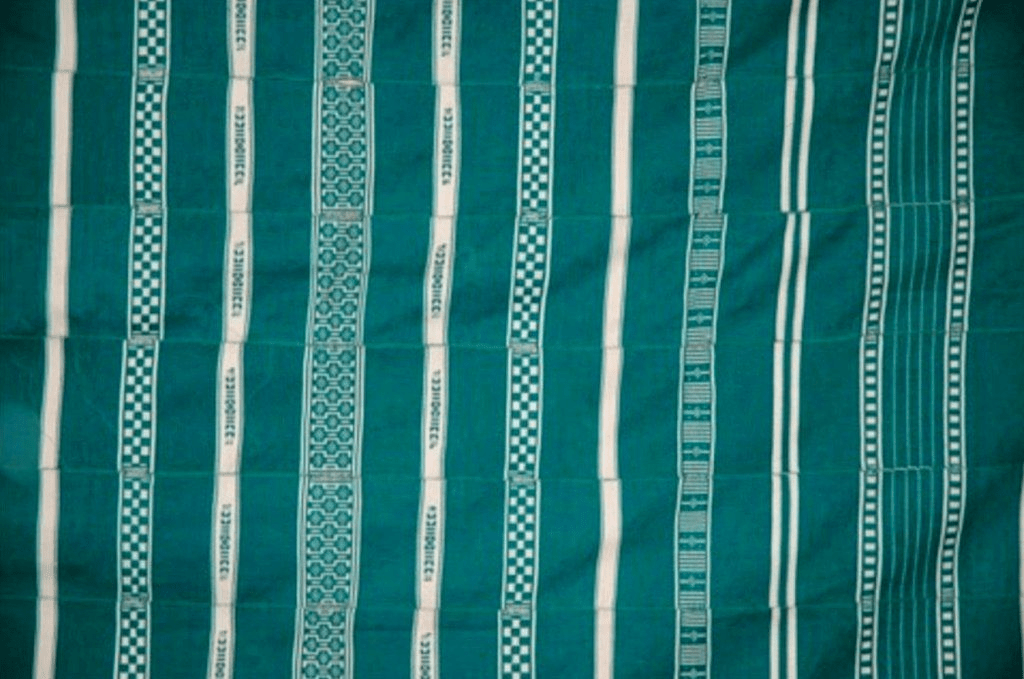
Songhay Fabrics [Fondo Kati Collection].
The morphology of fractal structures can be identified in decorated objects made of various materials from Africa, such as gourds, ladles, mortars, and knife sheaths. They are also found in ladles and gourds from Timbuktu and other places. Auguste Victor Dupuis-Yacouba, in Industries et principales professions des habitants de la région de Tombouctou [3], provides various examples of figures designed according to similar geometric patterns in the decoration of leather, jewellery, or ceramics.

Yacouba identifies similar geometric patterns in the decoration of leather, jewellery, or ceramics.
6
The same patterns found in fabrics, leather, and ceramics are found in African braiding. We observe perfect bilateral symmetry in the braids. It is an exact correspondence between two figures with respect to an axis, as in the animal and plant kingdoms, or a center, among others. This is a natural artistic canon.

The same patterns are found in African braiding. Photograph Gift Habeshaw on Pexels

Auguste Victor Dupuis-Yacouba – Industries et principales professions des habitants de la région de Tombouctou [p. 131].
7
The divinatory systems of the Bambara, the Songhay, and the Yoruba of Benin and Nigeria, among others, reveal the same geometric system at their core. In traditional Bambara divination, a diviner priest begins by rapidly drawing four lines of dots in the sand. He then connects the strokes two by two. For lines containing an odd number of strokes and ending up with one left over, he draws a single stroke. For lines with two strokes, he draws two strokes. He then repeats the operation. The mathematical operation is called “addition modulo 2,” which simply gives the remainder after dividing by two. But in this case, the two “words” produced by the priest, each composed of four even or odd strokes, serve as the basis for a new “addition modulo 2.”
In other words, it is a pseudo-random number generator, similar to how computers produce random numbers. It is also a numerical feedback loop, just as fractals are generated by a geometric feedback loop. Each combination corresponds to verses (“ese” in Yoruba) that tell a mythological story, a tale, a song, a proverb, a riddle… upon which the diviner will base his interpretation. In the Yoruba tradition, there are 16 verses for each odu/dou combination of the Fa, totaling a corpus of more than 4096 verses. In other words, when a question is posed to a babalawo (diviner), there are 4096 possible answers, that is, the same number of poems that the diviner must interpret to obtain an answer [4].

The sand drawings of the Chokwe people in Angola are complete graphs that must be drawn in a single stroke, without crossing an existing line or lifting a finger. These are what mathematicians call “Eulerian patterns”; they are taught to children in introductory stages. The fractal barrier of the Sahel, with its non-linear structures, is coherent with fractal theory, as is the Bamana sand divination system studied by my ancient philosophy professor, Mamadou Lamine Traoré, in Philosophie et géomancie: vers une philosophie originelle africaine [5]. In this system, 16 symbols are drawn in the sand. Each symbol is a 4-bit binary word generated by strokes indicating whether the number of strokes is even or odd: one stroke for odd and two for even. The first four symbols are generated randomly; the remaining 12 combine the previous symbols according to the logic that even plus odd equals odd, and odd plus odd equals odd. This is the logic behind the parity bit, a basic error-checking system used in computers to verify that data is intact. The parity bit is fundamental to all digital communication [6].
8
The rhythmic and melodic patterns of African music are also expressed through mathematical conceptual foundations like fractal theory and self-similarity. Thus, the music of the Ewe of Ghana, the Yoruba of Nigeria, and the Mandinka of Mali presents complex, self-similar rhythmic patterns that repeat at different scales.
The same forms we find in architecture, textile designs, house decoration, and musical patterns occur in African poetry. Let us examine here, with Tandina by Diadié Allou, and Bā Haddu and Ay Māma by the Timbuktu poet Aïssa Alamiridjé, three examples of poems with a marked fractal character:
Tandina
Tandina hey Alfa Cissé Mamadan
Tandina hey Alfa Cissé MamadanYuwar mē yenneri saney di salaamun nda ni
Sheebi mē yenneri saney di salaamun nda ni
Ankaba mē yenneri saney di salaamun nda ni
Hawlakata mē yenneri saney di salaamun nda niTandina hey Alfa Cissé Mamadan
Sama mā di ci wura Alfa Cissé Mamadan
Sama mā di ci badila Alfa Cissé Mamadan
Sama mā di ci al-lūlu Alfa Cissé Mamadan
Sama mā di ci al-mazan Alfa Cissé MamadanTandina heyfo Armā iye ni bey gābi mē
Fāyi di marrakāsin Armā iye ni bey gābi mē
Ulād marrakasin Armā iye ni bey gābi mē
Sharati marrakasin Armā iye ni bey gābi mēTandina hey kokoy ber ma boyrey mana
Sareykeyna albāsa saney ni salāmun’da ni
Yingareiber albase iye albāsa saney ni salāmun’da ni
Sidi Yahya albase iye albāsa saney ni salāmun’da ni
Hey, Bāyinde albase iye saney ni salāmun’da ni
Koy Sonkoré mē albase iye saney ni salāmun’da ni
Alkamsu albase iye saney ni salāmun’da ni
Sabābu albase iye saney ni salāmun’da niTandina heyfo kokoy ber hāma ndi ni
Mom yene Tandina hey Lāraw wōyo kamkam di niMawlād Idrisi Lāraw diyo nga kamkam ma na
Mawlād Sulaymān Lāraw diyo nga kamkam ma na
Mawlād Nāsibey Lāraw diyo nga kamkam ma naAy mow Bujbeyha Lāraw wōyo kamkam di ni
Ay mow Tawdenna Lāraw wōyo kamkam di ni
Ay mow Yarawān-ganda Lāraw wōyo kamkam di niTandina heyfo Arma ije ni bey gābi mē
Tandina hey Yoro yer ma koy Tūmbutu
Fāji di marrākasin Yoro yer ma koy Tūmbutu
Ulād marrākasin Yoro yer ma koy Tūmbutu
Sharati marrākasin Yoro yer ma koy TūmbutuSīdi bin Sīdi ni nga hōy nē herē mē
Kabitān al-Jinši Darā di yō nga hōy nē herē mēTandina hey Yoro yer ma koy Tūmbutu
Tandina hey lājaw koy ma lājaw mana
Šarati marrākasin lājoy koy ma lājaw mana
Ulād marrākasin lājoy koy ma lājaw mana.Tandina hey Yoro yer ma koy Tūmbutu
Surgo sārey zeyban zeyban wōyo nga wēle nda nō
Bon-fendu zeyban zeyban diyō nga hōy nē here mē
Cenga-bomo zeyban zeyban diyō nga hōy nē here mē
N’gorfu-hondu zeyban zeyban diyō nga hōy nē here mē
Tākūti zāri zeyban zeyban diyō nga hōy nē here mē
Gungu bomo zāri zeyban zeyban diyō nga hōy nē here mēTandina hey boro diyo go sallām ni ga
Tandina hey fo Surgo yo n’ga hamney mana
Yer mōw kel Yurgu Surgo yo n’ga hamney mana
Yer mōw Tenguereguef Surgo yo n’ga hamney mana
Yer mōw kel Kel Ta borīti Surgo yo n’ga hamney mana
Yer mōw kel Kel Ta Mulayti yo n’ga hamney mana
Yer mōw Ulimiden Surgo yo n’ga hamney manaTandina hey Alfa Cissé Mamadan
Sama mā di ci wura Alfa Cissé Mamadan
The rhythm read in the staves translates into fractal motifs. In “Tombouctou et la musique Arma,” its authors indicate that:
“This song can be framed within a binary meter; the lute, with percussion, performs a nine-measure introduction. We have transcribed the first stanza, since the rest repeats the music, albeit with different lyrics. Some stanzas contain a greater number of verses, but they always adapt to the same melody. The voice moves within a fourth, with a recitative and descending structure featuring conjunct degrees toward the conclusion. The note E is the lowest; it is also the point of rest and reference of the song. Periods in recitative mode with the reference on G—except the first time it occurs on A—and descents down to E constitute the work. The lute plays with four notes within the contour of a fifth, in turns of thirds, fourths, and fifths (resolving into fourths), with a rhythmic reference on the note A as the point of departure and return of the leaps. The rhythm forms a circle with a syncopated beginning, following the pattern of African rhythmic cycles [7].”

Theme and Variations – II
Unlike sonnets, where the same numbers of feet are found, here we see the different numbers of verses per stanza and words per verse:

the different numbers of verses per stanza and words per verse in Tandina

the different numbers of verses per stanza and words per verse in Tandina
Bā Haddu
Bā Haddu ijē ni mā ci mā
Bā Haddu Yahya ijē ni mā ci māJur go mēr
Jur go mēr
Jur go mēr
Arma ije gaMāma ijé ni mā ci mā
Arkia Māma ijé ni mā ci māMāma ijé ni mā ci mā
Sagaydu b. Hamān ni mā ci māMāma ijé ni mā ci mā
Amul Kālidi bin Ahaman ni mā ci māMāma ijé ni mā ci mā
Cīn Tafa bin Sīdi ni mā ci māMāma ijé ni mā ci mā
Cīn Jarrūku bin Sīdi ni mā ci māYā hafīyu
Yā salāmYā salām go yer taga ya
Yā hafīyu
Yā salāmBari di mā ci Abdu Salām
Bari di mā ci Abdu Wahab
A koy di mā ci Abdu l KarīmAy cin Bahadu ije ni mā ci mā
Mulfu sībi linji sara
Takuba tāci al-gauda fōYā hafīyu
Yā salām
Jur go mēr Arma ije ga
Wa lawkāna boro go būn
Bara yer ma tō ka dam boro
Wala yer ma tō ka kow boroMāma ijé ni mā ci mā
Towo amīrije ci ni cerē yaMāma ijé ni mā ci mā
Alkaidi Yahya ije ci ni cerē yaMāma ijé ni mā ci mā
Būya Bāba Adarawi ni mā ci māKoci lāmir har ni mā ci mā
Bannāni har ni mā ci mā
Bāsi goronte lāmir har ni mā ci mā
Kābu di lāmir har ni mā ci mā
Bāba al-Hayta lāmir har ni mā ci māMāma ijé ni mā ci mā
Arkia Māma ijé ni mā ci mā

This text […] ‘begins with an instrumental introduction of vièle (n’diarka) and percussion; the verses of the song, with instrumental solos, create variations of the melody. This alternation is free and enters into improvisation, bowing neither to fixed rules nor to strict periodicities. Each verse ends with a kind of glissando to return and take up the main theme. The voice moves within the contour of an octave, performing a recitative or psalmody in C, with descending turns and embellishments that conclude with this note. The vièle (n’diarka) performs a recitative in C and a descending movement to C, similarly rhythmized with a syncopated beginning. The tuning is very different from the Western one and presents great oscillation [8].
The graph of the metrical feet shows two phenomena: on the one hand, the text opens with the same rhyme repeated twelve times in the first verses and 11 times in the last ones. In the rest of the poem, self-similar elements occur at the beginning of the verses, giving a text that is cyclical in one part and highly uneven between the beginning and the end, with statistical elements that repeat through the changes. The number of verses per stanza is far more uneven than in Tandina. The number of words per verse is as well:

the different numbers of verses per stanza and words per verse in Ba Haddu

the different numbers of verses per stanza and words per verse in Ba Haddu
Ay Māma
Bisimillāhi go ay Māma ga mē
A wangay a wangey Māma ga mēAl Risāla dōn koy di ci Māma
Anna habī yay ci Māma
Anna habī Kalāmul rasul ci Māma
Alkāli Yahiya ije ci Māma
Alkāli hay alkāli ci Māma
Alkāli Bilal hāma ci Māma
Alkāli Abakar hāma ci Māma
Abdul Mulki Bāba yo hāma ci Māma
Sahaydu Tuttul Alkāli hāma ci Māma
Adaga Mahaman al-Kabir hāma ci Māma
Sīdi Mahamudu Idal Hamar hāma ci Māma
Idamar Aidal Hamar hāma ci MāmaCini bāna Banjugu bāna ma mōm
Cini bāna Banjugu bāna Abul BarakatiHammu bin Alrasul hāma ci Māma
Alfā Mōya Tamisikur hāma ci MāmaTuntun bani Lamtun ma mom
Asilihije bani Lamtun ma mom
Mahaman ije bani Lamtun ma mom
Jarrūku ije bani Lamtun ma mom
Lamtun ka bani Lamtun ma momKoy guna al-Risāla ra hay kan bā ma cow
Koy guna al-Lūmur ra hay kan bā ma cow
Ma koy guna Lahadari ra hay kan bā ma cow.
In this case:
[…] The vièle (n’diarka) and the voice are the sole instruments of this song. The vièle (n’diarka) begins promptly with chromatic scales, then gives way to the voice and plays in unison with it, performing various solos in a chromatic style. The voice moves predominantly within the range of a fifth, and continuously around E-flat. It also offers frequent chromaticisms alternating with recitative fragments. The vièle (n’diarka) performs a rhythmic function, of continuous excitement due to the movement of the bow upward and downward with great rapidity, in a kind of buzzing [9].


We face the same situation as in Ba-Haddu. The verses of the hedonist poetess Aissa Alamiridje respond to the rhythm of waves, both strong and weak.
9
The characteristics of the poems given as examples, both through their staves and their graphs, can be read through the geometry of fractals, both by a random series of repetitions at different scales and by similarity. There are different levels of orally composed and sung texts, accompanied by instruments, melodic motifs, and rhythmic motifs that recur with variations occurring in changes of rhythm, through verses and syntactic structures that create recursive patterns.
Depending on the scale at which the poem is read, metaphors and symbolism reveal a variety of non-linear interpretations.
The poems present narratives that interweave, creating a complex and broad image through patterns that repeat at different levels or in different poems. The fractal character of African oral poetry is expressed in the varieties of self-similar patterns.
The same characteristics are found in the Zarma-Songhay poetry of the Labezanga area and throughout the Songhay area from Niger to Benin. In Les Zamu ou poèmes sur les noms recueillis [translated and edited by J. Bisilliat & D. Laya, CNRSH, BP. 318, Niamey, Niger], the authors offer several poems that correspond to the descriptions given in these succinct observations. This poem is one of them:
Cambu Kasa Kassaaje wazaw
Cambu amiiru wande wazaw
gooro banda nii na wazaw
koyra banda nii na wazaw
hey Cambu Kasa Kasaje wazaw.Cambu rough rough broken
Cambu, the emir’s wife, broken
on the other side of the ditch, broken
behind the village, broken
hey, Cambu rough rough broken.
Also, W. H. I. Bleek and Lucy C. C. Lloyd, in Specimens of Bushman Folklore, collected various tales, myths, and songs of the Bushmen. Elias Canetti said (Canetti, 2009: 343-353): “This book has been in my possession since 1944, sixteen years ago. I have often come to think that it is the most important book among all those I know.” The collected texts correspond to the same characteristics of fractals. The songs of the paradise crane are a good illustration of this:
1
It is the story of the paradise crane that it sings: it sings (about) its shoulder, sings that the hip pearls of the “krieboom” are on its shoulder; it goes about singing –
The bayas are on my shoulder,
The bayas are on my shoulder,
the pearls are on my shoulder,
The bayas are up on my shoulder.
The pearls are up (on his shoulder).
Rrrú are above;
the hip pearls are above,
Rrrú are up here;
they are up here;
the bayas, rrú, stay (on) his (shoulder).2
(When running, fleeing from a man)
A splinter of stone that is white,
A splinter of stone that is white,
A splinter of stone that is white.3
(When walking slowly, leaving the place [peace walk])
A splinter of white stone.
A splinter of white stone.4
(When it beats its wings)
Scratch (the gazelle skin) for a bed.
Scratch (the gazelle skin) for a bed.
Rrrrú rrra,
Rrrrú rrra,
Rrú rra!
Theme and Variations – III

After ‘L’esthétique négro-africaine’. Collage Ismaël Diadié Haïdara
10
Recursivity in the Tebrā’a is seen in the copying of a first verse taken from an old poem or created previously, to which a second verse is added, as in the case of these poems cited by Aline Tauzin in her article “A haute voix. Poésie féminine contemporaine en Mauritanie” (Revue du monde musulman et de la Méditerranée, no. 54, 1989):
men meten sqamu
tâlet eeleye 1-eyâmuHis intense love
Makes my days so longmen meten sqamu
nesmae men tûnes kalâmuBy the strength of my love for him,
I hear his words from Tunis.
Tauzin (1989: 4) discovers another form of memorisation or homophony of terms used that are applied in the development of a new poem, as can be seen in pieces where the poem is organised around the word quwwa, the last verse of the first poem / kuwwa, the first verse of the second poem; terms used, and which we can assume are also applied when developing a new poem. Thus, in the following pieces, where the texts are organised around quwwa (last verse of the first poem) / kuwwa (first verse of the second poem):
šivtu vē l-wētē
lā howlē u lā quwwatā
I saw him in the car.
Only God could have made him so beautiful.
šivtu ma`a sl-kuwwa
là neabudu illâ huwa
I saw him in the window.
There is no devotion except toward Him.
In a third case, we see the repetition of a verse without any modification (Tauzin, 1989: 5):
Sivtu maea dl-kuwwa
xalla glaybi alla yetlowwaI saw him in the window.
He made my heart race.
Another manner is the use of terms from the same semantic field such as axdar, dark complexion, and asfar, light complexion.
ana mesquins
men had axdar va 1-hukûmsI am in love with someone
of dark skin in the government.fweyleh u ba-dâtu
had asfar râvad keyyâtuHe is attractive and handsome,
the one of light complexion who carries his notebooks.
11
Leopold Sédar Senghor, in “L’esthétique négro-africaine” (Diogène, no. 16, Paris, 1956), following the path of Placide Tempels in Bantu Philosophy, starts from the postulate of the existence of an African soul defined as a vital force that expresses itself through art. African aesthetics is therefore founded on a participatory relationship with the world, where art expresses the vital breath that animates the universe. The central principle of this aesthetics is rhythm, the organising force that structures forms, colours, gestures, sounds, and words, revealing the inner energy of beings. Thus, for Senghor, sculpture, dance, poetry, or the mask do not merely represent reality: they manifest living and spiritual forces. This aesthetics is equally based on intuitive and participatory knowledge. The African artist enters into communion with the world; he does not contemplate it from a distance through the order of reason. In this perspective, “emotion is black and reason is Hellenic.” Art thus has the function of revealing the vital force present in beings and in the cosmos. Beauty resides less in the faithful imitation of reality than in the work’s capacity to make perceptible the profound unity between the human being, nature, ancestors, the sacred, and the universe. In this way, art appears as a language of vital energy and as a mediation between the visible and the invisible.

Leopold Sédar Senghor
It must be remembered here, with Karl Popper, that any proposition that cannot be submitted to empirical verification or refutation does not belong to the domain of science. Now, the existence of an “African soul” or an “African vital force” is not given anywhere in experience. These notions belong rather to the terrain of cultural metaphysics than to that of scientific knowledge. They express a vision of the world, but they do not describe empirically observable realities. Consequently, on the aesthetic and anthropological plane, that which is not empirically given cannot be elevated to the rank of a postulate nor generalised as a description of a cultural form reduced to a supposed “essence.” To do so is to substitute the observation of historical and cultural diversity with an abstract and essentialist category that finds no foundation in experience.
Starting from the observation of what African artistic productions have empirically in common, we can by deduction define this aesthetics more accurately, and what they have in common is the internal structure of their productions. This aesthetic form is founded on a real knowledge of what Benoît Mandelbrot would one day call fractals. This practice of fractals in African art does not come from an intuitive exercise, but from a knowledge integrated into a culture.
In contrast, the American Ron Eglash begged the question by asking whether the Africans who practiced fractals knew they were making fractals. Many give an aesthetic or technical rationale. But the problem lies in the question and not in the answer. Eglash remains tributary to the language of modern mathematics: he first identifies fractals and then seeks their presence in African cultures on the one hand, and on the other hand, tries to see whether those who practice these geometric forms have knowledge of their formulation in contemporary mathematical discourse.

Fractals do not belong exclusively to the discourse of modern mathematics. Design Samuel Monnier. Wikimedia commons
According to Roger Penrose, the deepest mathematics are not simple human constructions: they constitute a realm of objective truths, eternal and independent of us, which mathematicians progressively discover through reason and intuition. Starting from the premises of Roger Penrose, one can say that, from a Platonic point of view, this would mean that fractal principles existed independently of their modern scientific formulation. According to Roger Penrose then, later academic mathematics did not create these structures, but rather gave them a formal language in a different epistemological discourse. It is necessary, however, to go one step further and affirm that to know a rule and apply it is to have knowledge of it and to apply what is known in different areas with repeated experience and verifiability in the application. The theory is the rule elevated into a language, in this case, mathematics. We are at two levels of language. Simple intuition does not lead to the avoidance of errors and the therefore to the ability to apply a rule in a variety of areas. The rule must first be known. For a pre-existing mathematical structure to manifest itself in a cultural practice, a process of learning, observation, transmission, and understanding must have been mediated.
In other words, the objective existence of a mathematical truth does not substitute for the human knowledge necessary to access it. At this level, it must also be clear that there is no “doing” without a “knowing” that precedes and grounds it. Moreover, if in all doing there is a knowing, we will accept that there are no facts without their epistemological framework. Consequently, theoretical discourse or mathematical knowledge is only the expression in a formal system that belongs to an order of discourse, a different discursive reality.
Mathematical theory does not constitute the origin of knowledge of a structure, but is one of its possible forms of expression. Where a systematic, transmissible, and verifiable practice exists, knowledge already exists. Mathematical formalisation does not create that knowledge; it translates it into a distinct discursive regime, endowed with its own rules of demonstration, abstraction, and universalisation. There is a plurality of epistemological worlds. One form of expressing knowledge is not superior to another; it is different, it is a different language, with its own grammar. There is knowledge of fractals that is expressed in experience in Africa; there is a mathematical discourse applied to experience.

This practice of fractals in African art does not come from an intuitive exercise, but from a knowledge integrated into a culture Photograph Vurzie Kim on Pexels
In another discourse, as in Western mathematics, other forms can be expressed in this other kinds of formal discourse. Fractals do not belong exclusively to the discourse of modern mathematics. Before their academic formalisation, forms of knowledge capable of identifying, producing, transmitting, and applying them in architecture, urbanism, craftsmanship, or aesthetics existed in Africa and elsewhere. That knowledge possessed its own logic, its procedures of validation, and its own cultural grammar. Modern mathematics does not substitute for it nor invalidate it; it simply expresses it anew in another language, subject to other rules of demonstration and abstraction. From this perspective, the difference would not be between “knowledge” and “absence of knowledge,” but between distinct epistemological worlds.
In this sense, the question ceases to be “did they know fractals?” and becomes: what form did fractal knowledge take within that cultural universe, and what were its own mechanisms of transmission, legitimation, and application? That question recognises the plurality of the languages of knowledge without denying the possibility that all of them refer to the same structures of reality. As Ubiratan D’Ambrosio saw it in Ethnomathematics: Link between Traditions and Modernity (2006): Mathematics does not constitute the exclusive patrimony of one civilisation, but a plural set of modes of organising, quantifying, measuring, modeling, and understanding the world.
Following the discovery of fractals in Africa, the question is not whether they knew what they were doing by applying fractals in their daily life, but rather, what type of discourse the fractals apply to and what they express, because there is no practice without knowledge. The presence of fractals in African practices does not raise the question of the existence of knowledge, for all coherent practice presupposes knowledge. The question is to determine the discursive regime in which that knowledge is expressed. Modern fractal geometry constitutes a particular formalisation of those structures, but is not necessarily the only language capable of knowing them. In any event, formalisation has the tendency to be Procrustean. African fractals thus refer to a plurality of epistemological worlds in which the same reality can be thought, transmitted and applied according to different grammars of knowledge.
12

We close these written variations “à sauts et à gambades,” as Michel de Montaigne would say of his own Essais, referring to the chaotic character of his style. The poem Tandina presents a free verse structure, without fixed metre or regular rhymes, characteristic of African oral poetry. Its structure does not conform to Western stanzaic norms, but rather to a performative, rhythmic, and accumulative logic. The most significant structural element is the presence of a repeated refrain: “Tandina hey Alfa Cissé Mamadan,” which constitutes the structural core of the poem. This refrain appears successively, marking the beginning or the end of each block and serving as the guiding thread that connects the argument. Thanks to this refrain, the poem is structured into thematic sequences or segments linked by formal repetition. Within these blocks, syntactic parallelism predominates, with many verses repeating the same grammatical structure with lexical variations. For example, phrases such as “X mē yenneri saney di salaamun nda ni,” “Sama mā di ci…” or “Yoro yer ma koy Tūmbutu” demonstrate how a stable base is maintained while specific elements (proper names, places, attributes) are replaced. This method produces an accumulative enumeration, where relevance expands gradually through the incorporation of new elements. The poem presents a clear recursive or self-similar structure. Each block reproduces, on a smaller scale, the same motif that constitutes the whole, resulting in a repeated formula with variations. The structure is not linear, but extended and potentially infinite, since new elements can be incorporated without altering the fundamental form. This characteristic allows us to establish a connection with Ron Eglash’s “African fractals.” From this perspective, the diverse cultural expressions of Africa are structured through the principles of self-similarity, repetition with variation, and hierarchical structuring. In the poem, these principles are reflected in the reiteration of motifs at different levels: the refrain (macro level), the thematic blocks (intermediate level), and the individual verses (micro level). Thus, we can affirm that the poem possesses a structure similar to that of a fractal, both in a formal and analogical sense, where each part reproduces the functioning of the whole.

Tebræ is a song form used by Malian woman. Old postcard
In summary, the text integrates characteristics of orality—such as repetition, parallelism, rhythm, and its ritual dimension—within an internal organisation based on recursivity and self-similarity. This allows us to interpret it, from a contemporary perspective, as a form close to the principles that define what are called African fractals. All the poems of the African oral tradition reproduced here, such as those of the Songhay, the Bushmen, and the Songhay-Zarma, exhibit the same motifs characteristic of fractal objects. Therefore, we can affirm the existence of an African aesthetic based on the structural principles of such objects, which manifests itself through various forms of expression, such as oral poetry. Many African cultural traditions show a tendency toward repetition with variation, self-similarity—that is, the presence of the same motifs at different levels—and the use of recursive and expansive structures. These characteristics appear not only in fields such as architecture or the visual arts, but also in the oral tradition, where a central refrain organises the whole, the different blocks repeat similar motifs, and each part reproduces, on a smaller scale, the logic of the whole, giving rise to a dynamic, open, and accumulative form. In this sense, Ron Eglash’s studies on so-called African fractals allow us to interpret these motifs as part of a broader cultural logic, characterised by hierarchical ordering, iteration, and modular structural organisation.
All of the foregoing is nothing more than a set of brief observations on the internal structure of what we may call an African aesthetic and epistomological discourse. From common empirical traits in African artistic productions, we can identify fundamental elements and define its aesthetic with greater precision than approaches such as that of Senghor, who, in L’esthétique négro-africaine (Diogène no. 16, Paris 1956), inspired by Tempels (Bantu Philosophy, 1945), attributes it to a supposed vital force of an African soul.
NOTES
[1] https://www.science.org/doi/10.1126/science.156.3775.636
[2] Ron Eglash. African Fractals: Modern Computing and Indigenous Design. Rutgers University Press, 1999. ISBN: 978-0813526140.
[3] Auguste Victor Dupuis-Yacouba. Industries et principales professions des habitants de la région de Tombouctou. Larose, Paris, 1921.
[4] Mamadou Lamine Traoré. Philosophie et géomancie: vers une philosophie originelle africaine. Donniya, Mali, 2007. ISBN: 2-911741-50-1.
[5] See: https://www.youtube.com/watch?v=P92gvVVVFcQ&t=31s.
[6] This song can be framed within a binary metre. The lute, with percussion, presents a nine-bar introduction. We have transcribed the first stanza, as the remainder repeats the music, albeit with different lyrics. Some stanzas contain a greater number of verses, but they always adapt to the same melody. The voice moves within a framework of a fourth, with a recitative and descending structure with conjunct degrees to the conclusion. The note E is the lowest, also the point of rest and the reference of the song. The periods in recitative mode with the reference on G—except the first time, which is on A—and the descents to E make up the work. The lute develops with four notes within the contour of a fifth, in turns of thirds, fourths, and fifths (to resolve into fourths), with a rhythmic reference on the note A, the point of departure and return of the leaps. The rhythm forms a circle with a syncopated beginning, following the pattern of African rhythmic cycles. / https://www.youtube.com/results?search_query=Le+mali+des+sables+Les+Songoy
[7] …begins with an instrumental introduction of violin (n’diarka) and percussion; the stanzas of the song, with instrumental solos, create variations of the melody. This alternation is free and ventures into improvisation, without following fixed rules or strict periodicities. Each stanza ends with a kind of glissando to return to the main theme. The voice moves within the contour of an octave, creating a recitative or psalmody on C, with descending turns and ornaments that conclude on this note. The violin (n’diarka) creates a recitative on C and an equally rhythmic descending movement towards C, with a syncopated beginning. The tuning is very different from the Western one and presents a great oscillation.
[8] The violin (n’diarka) and the voice are the sole instruments of this song. The violin (n’diarka) begins with chromatic scales to give way to the voice and play in unison with it, performing various solos in a chromatic style. The voice moves predominantly within a fifth and a continuum around E flat. It also presents frequent chromaticisms that alternate with recitative fragments. The violin (n’diarka) fulfils a rhythmic function, of continuous emotion due to the movement of the bow upwards and downwards at great speed, in a kind of drone.
*This article is a translation by Philip Hall and is an extended version of the original essay by Ismaël Diadié Haïdara published first at Cafe Montaigne.
Exiled in Spain since 2012, ISMAËL DIADIÉ HAÏDARA (Timbuktu, 1957) is a librarian, poet, philosopher, historian, president of the Mahmud Kati Foundation in Spain, and director of the Kati Fund Library in Timbuktu, Mali. Gold medalist of the city of Toledo – Spain and member of Sites of Conscience in New York, he studied drama at the National Institute of Arts (INA) in Bamako and philosophy at the École Normale Supérieure (ENSUP) in Bamako, Mali. He is the author of several works and articles, including: Le statut du monde. Nécessité, possibilité et contingence chez Ibn Arabi, Cordoba, 1992 ; Yawdar Pasha y la conquista saudí del Songhay (1591-1599) Instituto de Estudios almerienses, 1993 et Rabat 1996 ; L’Espagne musulmane et l’Afrique subsaharienne, Editions Donniya, Bamako, 1997 ; Les Juifs à Tombouctou, Editions Donniya, Bamako, 1999 ; Los otros Españoles, mr ediciones, Madrid, 2004 ; Los últimos Visigodos, rd editores, Sevilla, 2003 ; Las lamentaciones del viejo Tombo, Maremoto, Málaga, 2006 ; Abana, Rihla, Córdoba, Almuzara, 2006 ; Monólogo del un carnero, Árbol de Poe, Málaga, 2012 ; Zimma, Vaso Roto Mexico, 2014 – Madrid 2015 ; Tombouctou, Andaluces en la ciudad pérdida del Sahara, Almazara, 2015. Une cabane au bord de l’eau, Genal, Málaga, 2016; Tebrae pour ma mère, Málaga, 2017 ; Sahel, Málaga 2017 ; Journal d’un bibliothécaire à Tombouctou, Almuzara, 2017. De Tolède à Tombouctou, Malaga, 2019. De la Sobriedad, Almuzara, 2020 ; Tebrae, Libros del Aire, Serie Mayor, Boo de Pielagos, Cantabria, 2021.
Discover more from Ars Notoria
Subscribe to get the latest posts sent to your email.


Comment
Comments are closed.