
‘Impossible Dream’. Illustration by Martin Rowson, first published in The Guardian
WHAT BUTTERS OUR BREAD
Genuine social change alters values and redefines what is considered to be good art and literature. One of the reasons for starting Ars Notoria was to open doors to all kinds of people and allow them to express themselves, and to be seen and read and heard.
The English Revolution, the French Revolution and the Mexican Revolutions, liberated suppressed creative energies and gave voices to artists and writers previously ignored by the authorities. Even before the French Revolution, there was Voltaire, Rousseau, Diderot, Thomas Paine, Jacques-Louis David, Pierre Beaumarchais, Jean-Paul Marat, Jacques-Pierre Brissot, and Cesare Beccaria. These people pointed out what was wrong with French society and pointed out what wonders the future could hold if one day France and Europe were freed from the control of the aristocracy. They were pathfinders.
Would it be fair to say that the cultural heights of our society are dominated by the people who pay the piper to play the tune? We think so. These media and publishing companies are often the same ones who are gung ho for war and dead set against socialist politicians.
Ars Notoria collects wild yeast to help the literary and artistic dough rise under a broadly humanist and socialist outlook. Ars Notoria is meant for people who desire another kind of society. We want to help propitiate a post-capitalist, post-scarcity, tolerant and inclusive society free from the military-industrial complex.
Consider how the current system of literary manufacturing operates: a well-known writer was gradually unpublished and ignored until she came crawling back to the editor of a prestigious literary magazine who had refused to give her a good review. She asked him: “Tell me what I am doing wrong.” Through a series of exchanges, he reshaped her writing to his own taste. Only then was she celebrated, feted, and welcomed into the golden circle. Her politics are now even more beautifully obscure and unthreatening.
Closed insular loops of praise and mutual self regard transform literary and artistic self-betrayal into high aesthetic achievement, producing work that never rocks the status quo.
What really disgusts us all is not the humiliating compromises genuinely good writers and artists of all kinds are forced to endure. The real horror is the spectre of such wasted human potential. The dismantling of cultural shibboleths and the de-sanctification of establishment icons are essential to clearing a path for many towards revolutionary, creative freedom.
Right now, at the political centre, the ersatz left embraces socially progressive rhetoric while abandoning agendas for economic redistribution and social inclusion. Increasingly, Europeans find ourselves stranded in a slowly decaying, privatising social infrastructure as wealth inequality increases and accentuates. We seem helpless to stop it, whichever party we vote for.
Meanwhile, Europe is entangled in an unwinnable conflict with the Russian Federation with its military and economic strength eroding. Abandoned by our governments, Europeans face economic ruin and the severe existential threats which are the result of this strategy of brinkmanship. European taxpayers are paying for a failed US imperial gamble that threatens to bankrupt and side-line Europe. Perhaps that was the intention.
The Prime Minister could show backbone, protect domestic social infrastructure, and reject warmongering. Don’t we share the desire in Europe to decouple our economies and societies from pursuing corporate wet dreams of lebensraum? Andy Burnham has no mandate to drag the British public into war.
In the Middle East, most of us understand that Israel’s integration as a responsible, secular, inclusive nation into the broader region would serve its people’s interests and bring about peace. The majority of Israelis have deep regional, Arab-Jewish (Mizrahi) roots in the Arab world and nowhere else to go. The current endless war is the result of the suicidal pact between some Israelis and the same US global interests that drive the proxy conflict in Europe, and who now threatening to unleash another war — with the People’s Republic of China, for heaven’s sake!
Top-down reform from the institutions that profit from war and exploitation won’t happen without lots of pushing. It is only through collective action, trade union solidarity, and intelligent, direct forms of resistance in all areas, including cultural forms of resistance, that we can hope to survive this end of an era marked by zero-hours contracts, imperial decline, global warming, and the technological displacement of human beings from the workplace.
Ars Notoria throws open the doors to poets, painters, essayists and visionaries who are discontented with capitalism raw in tooth and claw, but who celebrate human pleasures and the human spirit and all who care for the environment. The stories, poems, artwork, and polemics assembled in this issue are not always polite literary and artistic adornments. The cultural dough rises with the collective imagination of the people, and deflates with the carefully curated squitterings of the favoured literary and artistic progeny of the Western ruling class.
A CONVERSATION WITH MARTIN ROWSON
– interview with Halas & Hall
Martin Rowson’s political cartoons started appearing in the national press in the 1980s, and he’s been metaphorically eviscerating the great, the good and the very bad ever since. He was appointed Cartoonist Laureate in 2000 (for which he received a stipend of a pint of beer a year). He ceased to be Cartoonist Laureate when Johnson became Mayor of London in 2008. On top of refusing to reappoint him, Johnson chucked out all the work Rowson had drawn, for free, for the People of London. Luckily a GLA employee rescued most of it. Martin Rowson is published in numerous outlets, including The Byline Times, The Morning Star, and particularly the Guardian (or rather The Graun). He probably would object to being called a Guardian stalwart, because it hasn’t always been a marriage made in heaven – Rowson is very much his own man and depicts people as he sees them, warts and all – but it has endured.
A great complexity of both images and ideas is apparent in all Rowson’s cartoons. Savage, scurrilous, visceral, as well as being highly well-informed, intelligent and insightful. He follows the traditions of the great late eighteenth century political cartoonists, lampooning all the pomp and ridiculousness of our betters, but there’s also an even more grotesque element to his visual style, reminiscent of the nightmare visions of Pieter Bruegel the Elder and Hieronymus Bosch. One also sees the more humorous grotesqueries of the strange beasts and gnome-like gargoyles that adorn many gothic cathedrals and churches. There’s a lot of devil in the details; simply glance over a Rowson cartoon and you’ve probably missed a big part of it.
Cartoonist, painter, author, illustrator, performer… We were meeting another of those damned polymaths.
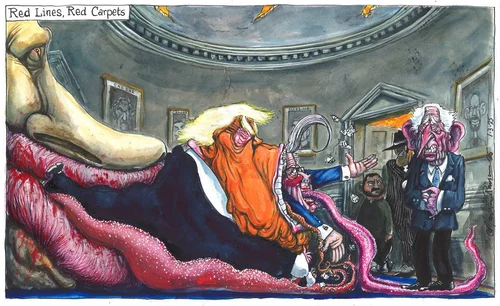
‘Red Lines, Red Carpets’. Illustration by Martin Rowson, published in the Tribune
Paul Halas: Pleased to meet you Martin. Maybe it would be helpful if we gave you a potted version of who and what we are before we really get going.
Martin Rowson: Hi… Please do. I hope you don’t mind if I carry on painting while we speak, because I can think and paint at the same time. I have this rush job which is a leaving present for Marina Hyde, who is leaving The Guardian.
Phil Hall: It’s like driving and talking, isn’t it? We can steam ahead.
Paul: So, Arsnotoria. We’re an arts, politics and general interest magazine. We espouse the idea of Humane Socialism, in all its many forms, and publish essays, photography, poetry, articles about food, stories, and of course art and interviews with artists… so we’re very pleased to be able to speak with you.
Phil: Ars Notoria… the art of the noteworthy. From a humane socialist point of view… so what is worthy of note from a humane socialist point of view? You qualify, certainly!
Paul: Maybe we can start with where you came into cartooning? You read English at Cambridge University I understand.
Martin: Yes, I read not very much English at Cambridge, as I always say. I hated that place. I hated the course. I hated the complacency. But I started doing cartoons for two-bit student papers and I enjoyed that. I got utterly bored and fed up with the whole place before my Part One exams. I deliberately wrote nonsense answers to the questions because I just wanted them to throw me out, but they didn’t. They said the responses were very clever, but they didn’t answer the questions. So I was given a sort of special degree, because, although I didn’t answer the questions, I was a smart boy. They’d given me an open award when I did the entrance exam, and then they knew they couldn’t admit they made a mistake.
Rather than wandering off into the darkness, I went back a year later, but most of the time I did the aforementioned cartoons for two-bit student papers. And I ended up with an eye-wateringly bad degree. But I had a very useful education in the importance of mastering a deadline, which wasn’t about writing essays. It all was about working for this magazine called Broadsheet, where we used to have wonderful paste-ups using offset litho. There would be film reviews, etc., and when they were pasted up there would be gaps on the page, which immediately needed to be filled by cartoons by me.
Paul: Were you politically motivated back then? Cambridge had the reputation for being a hotbed of communist spies.
READ ON…
IN THIS ISSUE
The Brickfields of Dhaka
Inge Colijn. A photo-essay and commentary on endurance and the struggle for a dignified living among Bangladesh’s brick kilns.
Poet of Honour: Ian Duhig
A selection of poems where Yogesh Patel honours Ian Duhig for his style, use of motifs from folklore, and for his contribution to English literature.
Letter to America: We Need Social Democracy
A political essay by Dave Blazer advocating structural social-democratic reform and robust public institutions in the United States.
Western Collateral Damage in Ukraine
Richard Steinhardt. A radical critique of the attempt of Western asset acquisition in Ukraine and the precipitant financialisation of Ukrainian assets
A Little Christmas Spirit
Arun Kapil. A delicious reflection on the Christmas holiday en famile; with cooking and eating at the heart of the celebrations.
The Catfish, the Cormorant and the Vanishing Barbel
Paul Halas. on threatened river ecosystems in England.
At Home in the Himalayas
Sudeep Sen. An essay on the mountain solitude of a poet, on finding sanctuary.
Part 9: Looking Ahead
David Yip. The ninth chapter of his memoir, ending it and looking toward to the future.
Diwali Chocolates
Yogesh Patel. A personal essay and recipe piece combining making chocolates with reflections on Diwali and a ‘chocolate poem’.
Calaverita to the Politicians
Ulises Paniagua Olivares. An essay on Mexican Day of the Dead customs using the traditional calaverita form, and a calaverita written by Ulises Paniagua satirising politicians.
Jon Stone
Sudeep Sen introduces the poet Jon Stone.
Poetics of the Tebræ
Ismaël Diadié Haïdara. An exploration of the exiled Malian scholar’s work on tebræ, traditional two-line forms developed by Saharan women.
Bronze Blues
We showcase Roger Murphy’s poetry, which, here, is full of strong imagery, melancholia and indignation.
Poetry as the Performative Homo Sapiens
Richard Reisner suggests that verse is an evolutionary, performative hallmark of human consciousness. He offers us his translation of Bolesław Leśmian’s poetry and one of his own poems.
The Encyclopædist
Peter Cowlam reviews a collection of poems by A. C. Bevan.
The Gallower
Poem of the Month. Gordon Liddle dedicates this poem to the memory of his grandfather, a miner who worked the pits in the North of England.
Chrysalis
Francesca Young describes her work as military horror. Often her stories takes place in a Science Fiction setting where a race of aliens has conquered the Earth.
A Review of Cormac McCarthy’s Blood Meridian
Martina Winter. A critical essay on Cormac McCarthy’s Blood Meridian.
Boots
Tina Bexson. This short piece that deals with trauma triggered by a visit to a shop. In this case the trauma experienced comes from fighting in the British Army in the war for the Malvinas.
Goznym: Leyla
J.W. Wood imagines the experience of having sex when plugged in to AI.
Somewhere Beyond Right and Wrong
An extract from Kishore Thukral’s novel. Here he introduces two of the novel’s protagonists..
Images and Words — Talking with Kerry Drumm
Halas & Hall have an in-depth conversation with the artist and playwright Kerry Drumm, who has won prestigious awards for her work.
Exhibition Amen
Zeek Fharkha is a South African artist. In this exhibition, in two of his paintings he memorialises his parents.
Beaux-Arts in the 21st Century
Ulises Paniagua Olivares reassesses the classical division of Beaux-Arts and asks for a broad discussion on a possible new classification for the Arts in an age of AI.
Atomic Tangerine Razzle Dazzle Rose, Screamin’ Green, Bittersweet Shimmer
Martina Winter. An essay about the evolving use of colour in art and politics.
The Great Improvisator
Norman B. Schwartz offers an insightful portrait of Franklin D. Roosevelt as a great actor; of his performances as a politician, and a view of the theatricality of FDR’s presidency.
An open Letter to Andy Burnham
An Ars Notoria Editorial where we beg Andy Burnham to make peace with the Russian Federation instead of escalating on behalf of US imperialism.
For a New British Liberation Theology…
Matthew Taylor. A theological treatise advocating for a new radical British liberation theology centred on the poor and marginalised.
Letter to ‘Ugly Americans’ in The Alternative Media
Richard Steinhardt. A critique the the self confident insularity and occasionally reactionary postures adopted by talking heads within the independent media in the USA.
Israel Must Embrace A Middle East Identity
Richard Steinhardt. A geopolitical essay arguing Israel should reject Western proxy status and embrace a native regional Middle Eastern identity.
The Russian Federation Roped the NATO Dope
Richard Steinhardt. A strategic military and geopolitical commentary the strategy of overreach between NATO and Russia.
Capitalist versus Socialist Innovation
Phil Hall. An economic comparison of how market-driven and state/public frameworks work to foster technological development.
Have You Been the Victim of Epistemic Terrorism?
Phil Hall. A critical essay on psychological gaslighting, information warfare, and narrative manipulation using AI.
A big thank you to everyone who contributes to Ars Notoria
More than 150 poets, philosophers, polemicists, critics, painters, commentators, illustrators, playwrights, novelists, satirists and experts in different fields have contributed to Ars Notoria over the last 6 years.
Ars Notoria Magazine has a publishing arm: AN EDITIONS
So far AN Editions has published four books. We have also produced two editions of two of those books. We will be publishing an additional 6 books in 2027. You can find out more about them here.
Ars Notoria Magazine & AN EDITIONS publish under the aegis of Humane Socialism
Our magazine stands for recognition and understanding of the human and humane, the broad idea of humanity and Humane Socialism in an era of digital brutality.
ARCHIVE
Monthly archive of Ars Notoria
Although we have been publishing articles since 2019 we have only been publishing issues of the magazine since 2024. You can access back issues here. They are archived by month.
-

Tebræ
Door in Mali, photo Leigh Voigt ISMAËL DIADIÉ HAÏDARA AND HIS EPIGRAMMATIC POETRY ISMAËL DIADIÉ HAÏDARA’s poems may speak of exile, but not in a predictable way that just invokes loss and sadness. He writes: “Exile is not sad. / Far from my home here is love, snow, the sea.” Tebrae is an aggregation of thoughts,…
-

NATO’S STRATEGIC DELUSIONS RISK WORLD WAR
The nuclear capable TU-160, Vitaly V. Kuzmin, Wikimedia Commons How many steps away are we from thermonuclear Armageddon? by James Tweedie, The war in Ukraine has now been raging for more than two years. While neither has published complete figures for its own casualties, methods such as monitoring online obituaries indicate that tens of…
-

PITCAIRN’S SIX FORGOTTEN MEN
The Polynesian Men of His Majesty’s Army Vessel, BOUNTY by Glynn Christian The trials and the contributions to Pitcairn Island of the Polynesian women who sailed aboard HMAV BOUNTY with Fletcher Christian have at last been more fully recognised by writers and historians. A few decades ago, a sign at the top of Pitcairn…
-

PART 1: WHAT WAS THE USSR?
The Icebreaker Yamal, made in a Leningrad shipyard in 1986, photo Pink floyd88 A personal view by Philip Hall In the first place, anyone who has been involved in the struggle against colonialism, neo-colonialism and imperialism in Latin America, Africa and Asia and in the more neglected parts of Europe understands that the USSR…
-

TWO NEW POEMS BY JULIAN STANNARD
Tobleronia Looking out of the windowlooking at the snowmade you feel drowsy.The train trundled along.You dozed off.You were asleep for too long.You missed that little villageon the hillwith its glühwein and chocolate fruit.You missed the Toblerone factoryand the ornate clock.You missed the Kunst Halleand the Rathouse.The train crossed the Rhine,crossed back again.You missed that…
-

TWO NEW POEMS BY A. F. MORITZ
When I Was a Child When I was a child it was clear the stones are alive. Plunging in tall grasses, almost lost to each other, we always were meeting them in the new trails each of us crushed, invisible to one another but near, calling out, smelling the faint sweetness in the afternoon…
-

TOILET HELL IN THE NORTHERN WASTES
by Jeremy Howe Jeremy Howe worked for major mining companies for thirty years and now lives on an island off the coast of British Columbia, Canada. Below he tells a tale of waste disposal, unwilling drillers, and an explosive end. Do not read this piece while eating. Back in the early to mid ‘90s,…
-

AI JAMES
Ars Notoria introduces its new literary chatbot Perhaps “proud” is not the right word, but we at Ars Notoria might be proud (we think) to announce the introduction of an AI-generated Avatar designed to make us more money than the billionaires we despise. We’ve given it the title of “Satire and Humour Editor” because, well,…
-

4. THE YIP FAMILY BOXING DAY
Margaret Yip in the 1970s by Margaret Yip It is 1974. Debts caught up with Martin up once again. We left Cardiff and returned to Barrow-in-Furness, where Martin found a job in a new paper factory. We rented one room in the centre of Barrow from the lady who owned the house. She lived…
-

MEMORIES OF OLD BABYLON
by Betty Hossaini Al-Hilla, ٱلْحِلَّة is only fifteen minutes away from Old Babylon. It is the capital of Babylon Province. When I was a child, I remember when they took me to Babylon. It was not like it looks like now, in modern times. Not at all! Babylon was a set of old walls…
You must be logged in to post a comment.